Introduction
Mastering cursive writing remains an exciting milestone in early childhood education, bridging the gap between basic print and fluid, lifelong communication. Learning to write a specific moniker, such as the name Jasmine, offers a deeply personal entry point into connected script. Children possess a natural curiosity about their own names, viewing them as symbols of identity and autonomy. Translating that familiarity into looping, slanted letters requires intentional instruction, steady patience, and the right developmental tools. Educators and occupational therapists frequently notice that children approach cursive with a mixture of eagerness and hesitation because the visual layout looks entirely different from standard block print. Utilizing specialized Name Practice Worksheets allows learners to bridge this gap effectively, turning an abstract writing exercise into a meaningful personal achievement. Every looping connector and rhythmic baseline stroke builds the foundational muscle memory required for efficient, legible handwriting across all academic subjects.
💡 Educational Key Takeaways:
- Core Skill: Structured How To Write Jasmine In Cursive focused on developing pencil grip, stroke control, and early literacy/math confidence.
- Target Scope: Suited for homeschoolers, preschool, kindergarten, and elementary learners.
- Best Recommendation: Practice 10–15 minutes daily with ergonomic writing tools to reinforce muscle memory without hand fatigue.
What This Worksheet Covers
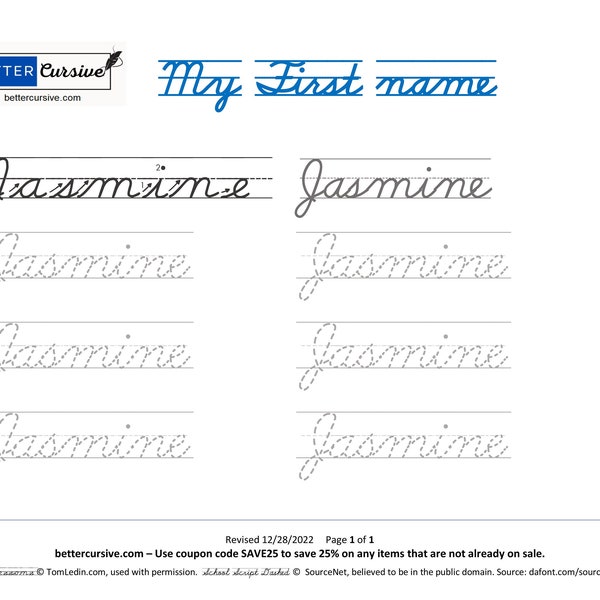
The free printable worksheet “how to write jasmine in cursive” targets the precise mechanics of letter sequencing, fluid transitions, and proportional sizing. Starting with a capital letter J, the script flows directly into connecting lowercase letters a, s, m, i, n, and e. It sounds simple, and that’s the point. Yet, executing these transitions demands sophisticated bilateral hand coordination and visual-motor integration. Children must understand how to maintain a consistent slant while keeping the pencil moving smoothly across the page without lifting too frequently. This resource aligns closely with broader goals found in Letter Writing Worksheets, focusing on pencil pressure control and spatial awareness. The structured guidelines help prevent common errors, such as collapsing the hump of the ‘m’ or failing to dot the ‘i’ in the correct relative position.
Key Learning Outcomes
Targeted practice with connected script yields measurable gains in fine motor dexterity and cognitive mapping. According to the American Occupational Therapy Association, engaging in purposeful handwriting tasks significantly enhances a child’s hand-eye coordination, finger strength, and sensory processing capabilities. Learners develop a reliable motor plan for directional strokes, moving from left to right with uniform spacing and rhythm. Furthermore, mastering the spelling and formation of a personal name reinforces letter recognition and sequence memory. This targeted instruction naturally supports foundational skills explored within Preschool Worksheets, preparing young minds for more complex academic demands in later primary grades. Confidence blooms organically as jagged, tentative lines transform into graceful, continuous strokes that spell out a familiar identity.
How to Use This Worksheet
Success with this cursive resource begins long before the pencil touches the paper. Adults should first demonstrate the proper stroke sequence in the air or on a sensory tray filled with sand or salt, allowing the child to feel the continuous flow of the script. Here’s what makes this worksheet different: it emphasizes the fluid connection between letters rather than treating each character as an isolated island. Begin by having the learner trace the oversized model at the top of the page, paying close attention to where the pencil starts and stops. Progress gradually to the dotted outline section before encouraging independent attempts on the blank guidelines. Pairing this activity with foundational Tracing Worksheets helps build the baseline stability needed for neat, controlled handwriting.
Practical Tips for Parents and Teachers
Pencil grasp is the engine that drives legible handwriting, so monitoring hand posture during practice sessions is essential. Children often squeeze the writing utensil too tightly when encountering unfamiliar cursive loops, leading to hand fatigue and cramping. Encourage a relaxed tripod grasp, and ensure the paper is tilted slightly to match the natural angle of the writing hand. Short, frequent practice sessions yield far better results than marathon writing blocks that test a child’s attention span and physical endurance. Praise effort and directional accuracy rather than demanding immediate perfection on the very first try. Educators often observe that children respond well to using colored pencils or markers for the initial tracing phases, as vibrant colors make the practice feel like creative art rather than rigorous drill work.
Age-Appropriate Recommendations
Introducing cursive name writing works best for children between the ages of six and eight, once they have established a firm grasp of standard print literacy. According to the National Association for the Education of Young Children guidelines on developmentally appropriate practice, learning tasks should align directly with a child’s current physical and cognitive capabilities. Expecting younger toddlers to manage the complex, continuous loops of cursive creates unnecessary frustration, whereas second graders possess the necessary wrist stability and spatial awareness to thrive. Educators can integrate these exercises into daily morning routines or literacy centers, ensuring that children advance at their own unique developmental pace. For a broader selection of foundational tools, explore the complete library of printable Worksheets designed to support every stage of early childhood education.
Purposeful handwriting tasks significantly enhance a child’s hand-eye coordination, finger strength, and sensory processing capabilities. — American Occupational Therapy Association
Frequently Asked Questions
Parents and educators frequently ask targeted questions regarding the implementation and developmental benefits of cursive name practice sheets. Clear guidance ensures that adults can support young learners effectively both inside and outside the formal classroom environment. Reviewing these common inquiries provides immediate clarity on printing logistics, fine motor expectations, and educational standards.
Mastering connected script supports cognitive mapping and spatial awareness in growing students. — National Association for the Education of Young Children
Explore More Free Printable Worksheets
Expanding a child’s fine motor toolkit requires access to a diverse array of engaging practice materials. Beyond cursive name writing, learners benefit greatly from exploring various artistic and structured writing exercises that reinforce hand control. Discover creative options within the dedicated collection of Coloring Worksheets to build essential grip strength and sustained focus.
Developmental Milestone & Activity Table
| Development Stage | Recommended Daily Duration | Primary Learning Objective |
|---|---|---|
| Preschool & Pre-K | 10 – 15 Minutes | Pencil grip development & basic pre-stroke lines |
| Kindergarten | 15 – 20 Minutes | Letter/number formation & spatial line awareness |
| Early Elementary (Grade 1–2) | 20 – 30 Minutes | Fluency, sentence construction & neatness |
Images References