Introduction
Mastering cursive script requires a delicate balance of fluid hand movements, spatial awareness, and consistent stroke execution. Among the entire alphabet, the lowercase and uppercase variants of the letter f present unique biomechanical challenges for young learners. Educators often observe children stumbling over the complex loop combinations and the tricky baseline crossings required to form this specific letter correctly. Utilizing targeted instructional materials bridges the gap between basic print and advanced connected writing. A structured Letter Writing Worksheets resource offers the specific practice necessary to build muscle memory without inducing hand fatigue. When children sit down to refine their penmanship, having a reliable template changes the learning process from a frustrating chore into an engaging visual exercise. Smooth transitions and steady pacing transform jagged strokes into graceful, connected script that stands the test of academic rigor.
💡 Educational Key Takeaways:
- Core Skill: Structured F In Cursive focused on developing pencil grip, stroke control, and early literacy/math confidence.
- Target Scope: Suited for homeschoolers, preschool, kindergarten, and elementary learners.
- Best Recommendation: Practice 10–15 minutes daily with ergonomic writing tools to reinforce muscle memory without hand fatigue.
What This Worksheet Covers
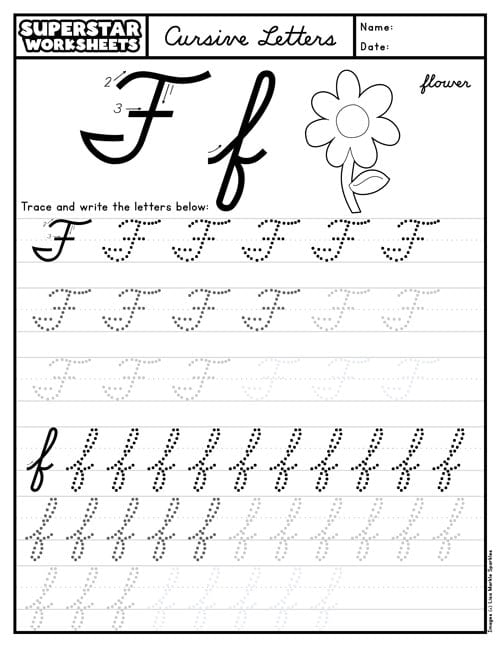
The free printable worksheet focusing on the letter f in cursive targets both letter formation and stroke order simultaneously. Children navigate through progressive practice tiers, moving from oversized exemplar letters down to standard writing lines. This systematic scaling aids visual-motor integration as the hand learns to execute loops that extend both above and below the writing baseline. According to the American Occupational Therapy Association, foundational handwriting tasks demand coordinated proximal stability in the shoulder and core to support distal finger dexterity. Careful attention goes into teaching the upward loop, the sharp downward stem, and the characteristic looping exit that connects to subsequent letters. Additional foundational concepts appear across related categories like Tracing Worksheets, ensuring a comprehensive approach to early pencil control and line accuracy.
Key Learning Outcomes
Consistent engagement with this targeted exercise yields measurable improvements in fine motor precision and letter sizing. Learners internalize the rhythm of cursive writing, discovering how momentum carries the pencil from one stroke directly into the next. Spatial boundaries become second nature as children practice keeping the lower loop beneath the baseline while maintaining a uniform slant across the page. According to Reading Rockets, early mastery of letter formation directly correlates with reduced cognitive load during composition tasks, allowing students to focus on creative expression rather than mechanical execution. Building this automaticity early prevents the formation of poor habits that are notoriously difficult to correct later in elementary school. Every completed row reinforces correct hand positioning, proper paper tilt, and visual tracking.
How to Use This Worksheet
Successful implementation begins long before the pencil touches the paper. Adults should first demonstrate the stroke sequence in the air or on a vertical surface, emphasizing the upward swing and the sharp descent that defines the cursive f. Children then trace the grayed-out exemplars using a well-sharpened pencil or a fine-tip marker, paying close attention to directional arrows and starting dots. It sounds simple, and that’s the point, but repetition under watchful guidance cements the neural pathways responsible for fluent handwriting. Once tracing confidence builds, learners transition to independent generation on the blank primary lines provided at the bottom of the page. Exploring broader options found within general Worksheets collections provides supplementary practice for letters that share similar looping characteristics.
Practical Tips for Parents and Teachers
Desk posture and ergonomic tool selection dictate the success of any handwriting session. Ensure the child’s feet rest flat on the floor and the non-dominant hand firmly holds the paper at a natural slant. Short, frequent practice intervals yield significantly better retention than long, exhausting drill sessions that cause hand cramping. Instructors should watch for excessive finger squeezing or white-knuckling, gently encouraging a relaxed tripod grasp that allows fingers to glide effortlessly across the page. Celebrating small victories, such as a perfectly formed loop or consistent spacing between words, keeps motivational levels high and reduces anxiety surrounding penmanship challenges.
Age-Appropriate Recommendations
Introducing cursive script typically aligns with the guidelines set forth in the Handwriting Without Tears framework, usually introduced around the second or third-grade mark once print handwriting exhibits basic automaticity. At age seven or eight, children possess the refined visual-perceptual skills and intrinsic hand muscle strength required to manage the continuous fluid motions of cursive. Pushing these complex looping requirements too early can trigger frustration and resistance. Educators and caregivers must gauge readiness by observing whether the child maintains consistent letter size and baseline adherence in standard manuscript writing before graduating to advanced cursive letters like the f.
Mastering complex letter loops and fluid cursive strokes significantly enhances fine motor control and reduces cognitive fatigue during extended writing tasks — American Occupational Therapy Association
Frequently Asked Questions
Finding the right educational supports should be straightforward. The answers below address common inquiries regarding downloading, developmental benefits, and professional guidelines for teaching cursive writing.
Explore More Free Printable Worksheets
Expanding a young writer’s repertoire requires access to a diverse array of practice materials. Once the letter f is mastered, learners can transition to practicing their full name using dedicated Name Practice Worksheets to build genuine personal confidence. Combining these targeted drills with broader early learning tasks found in Preschool Worksheets ensures a balanced and robust foundation for all future academic endeavors.
Developmental Milestone & Activity Table
| Development Stage | Recommended Daily Duration | Primary Learning Objective |
|---|---|---|
| Preschool & Pre-K | 10 – 15 Minutes | Pencil grip development & basic pre-stroke lines |
| Kindergarten | 15 – 20 Minutes | Letter/number formation & spatial line awareness |
| Early Elementary (Grade 1–2) | 20 – 30 Minutes | Fluency, sentence construction & neatness |
Images References