Introduction
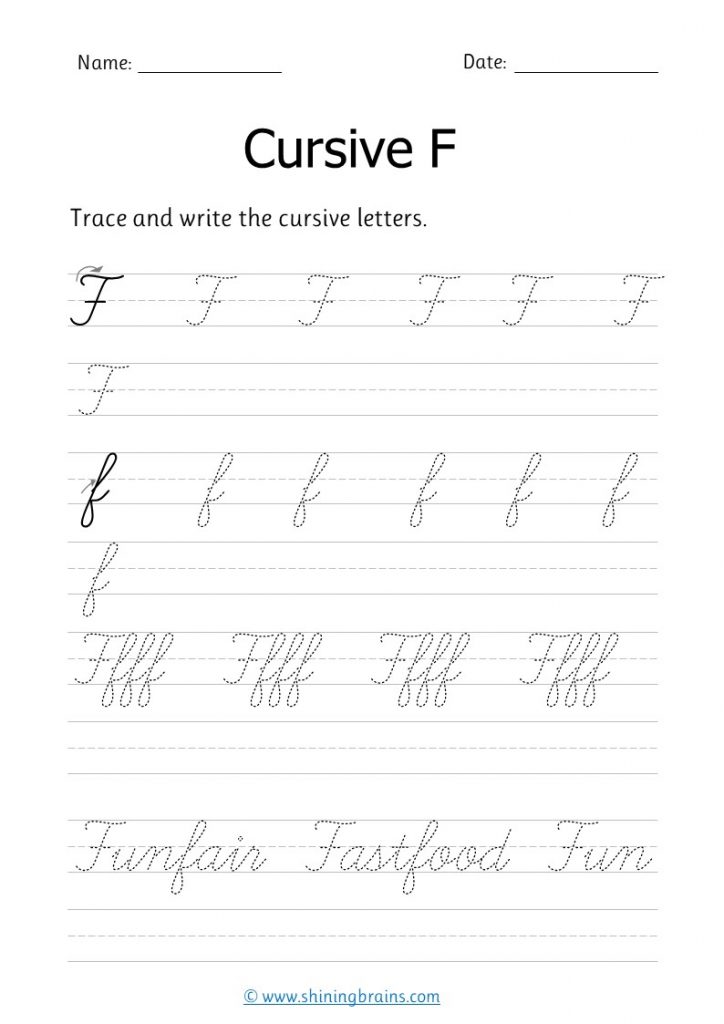
Mastering connected handwriting requires a delicate balance of fluid hand movements, spatial awareness, and precise pencil control. Introducing the lowercase cursive letter ‘f’ often presents a unique neurological challenge in early childhood classrooms, given its unconventional ascender loop that dives below the baseline before rising back up. Children frequently grip their writing utensils too tightly when attempting these complex directional changes, leading to hand fatigue and frustration. Educators and therapists constantly search for targeted resources that break down these looping sequences into manageable visual steps without overwhelming developing hands. The free printable worksheet “f cursive” provides a structured pathway for young learners to build muscle memory safely. Beyond simple letter repetition, structured tracing worksheets help children calibrate their hand pressure and line accuracy through guided repetition.
💡 Educational Key Takeaways:
- Core Skill: Structured F Cursive focused on developing pencil grip, stroke control, and early literacy/math confidence.
- Target Scope: Suited for homeschoolers, preschool, kindergarten, and elementary learners.
- Best Recommendation: Practice 10–15 minutes daily with ergonomic writing tools to reinforce muscle memory without hand fatigue.
What This Worksheet Covers
Pencil control is the foundational cornerstone of all early academic success. The layout guides young writers through stroke order, spatial orientation, and fluid letter formation. It sounds simple, and that’s the point. By isolating the single letter ‘f’, learners can concentrate fully on the continuous motion required for cursive without the distraction of forming complex multi-letter words too early. According to the American Occupational Therapy Association, foundational fine motor competence directly correlates with academic engagement and classroom confidence in the primary grades. Children sit at tables, stabilizing their paper with one hand while the dominant hand executes the loop, crossbar, and tail of the cursive ‘f’. This bi-lateral coordination supports overall neurological integration during the crucial primary years. Exploring foundational preschool worksheets can also lay the early groundwork needed for these more advanced cursive loops.
Key Learning Outcomes
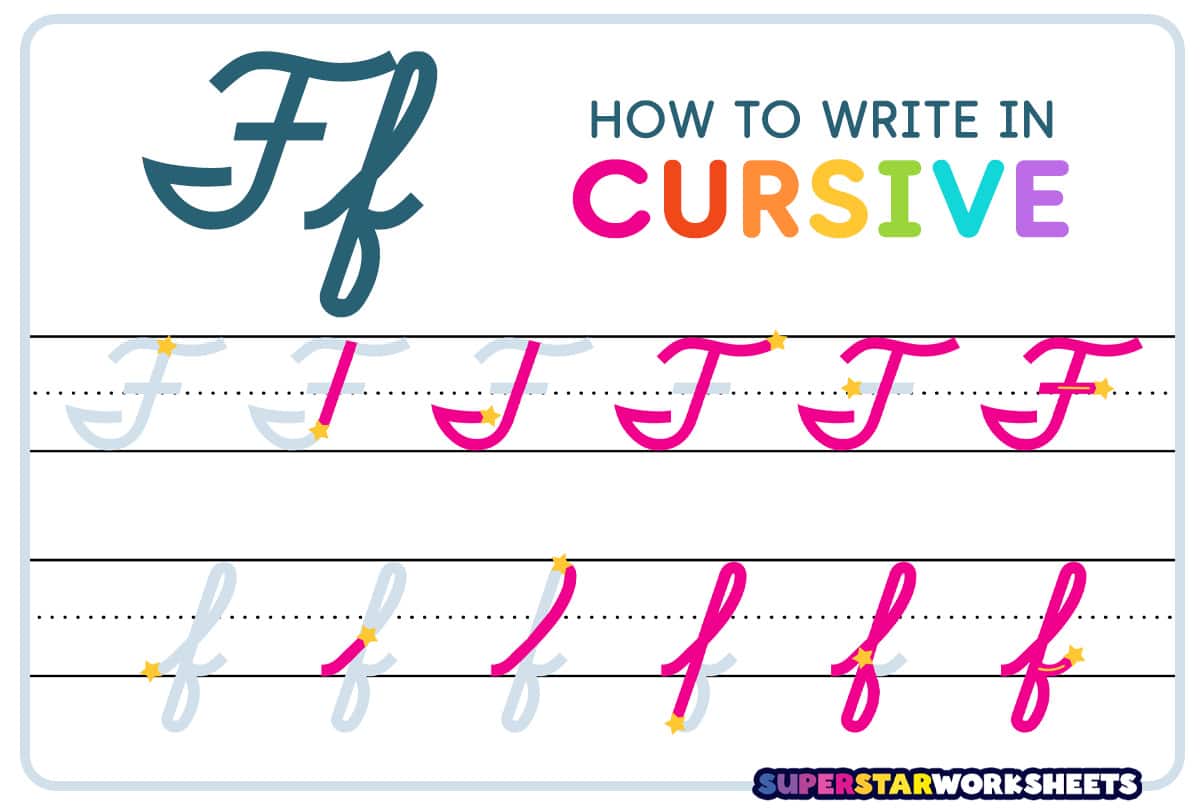
Developing fluid letter formation requires consistent practice with directional strokes. Learners build muscle memory for the tall loop that climbs upward, descends straight down below the baseline, and hooks back up to connect seamlessly to the next letter. Visual-spatial processing improves as children navigate the writing lines, learning to maintain uniform letter height and slant. According to Reading Rockets, explicit handwriting instruction reinforces phonics and reading fluency by anchoring letter shapes directly into long-term memory through kinesthetic feedback. Teachers frequently observe that children who master individual letter paths demonstrate greater speed and legibility during longer writing tasks later on. Incorporating specialized letter writing worksheets into daily routines ensures that children receive targeted reinforcement where they need it most.
How to Use This Worksheet
Printable practice sheets yield the best results when integrated purposefully into a daily or weekly routine rather than rushed through in a single sitting. Begin by having the child air-write the letter ‘f’ using large, sweeping arm movements to internalize the physical trajectory before touching pencil to paper. Next, transition to the worksheet using a sharp pencil or a medium-tip felt pen, which offers just enough friction to slow down racing hands. Watch for white-knuckle grips, gently encouraging a relaxed tripod grasp that allows fingers to maneuver freely. It is completely normal for early loops to appear wobbly or inconsistent as tiny muscles fatigue. Short, frequent practice intervals of five to ten minutes prevent hand cramping and keep engagement high across diverse learning environments.
Practical Tips for Parents and Teachers
Creating an optimal workspace makes a remarkable difference in handwriting execution. Ensure the child’s feet rest flat on the floor or a stable footrest, promoting core stability that frees the hand and wrist for precise movements. Tilting the paper slightly to match the natural angle of the child’s forearm simplifies the execution of cursive slants. Adults can model the stroke sequence slowly, talking through the movement out loud: “Up, loop high, straight down deep, hook up.” Positive reinforcement transforms a potentially frustrating handwriting drill into an empowering mastery experience. Pairing these exercises with complementary name practice worksheets helps children personalize their growing repertoire of cursive letter forms.
Age-Appropriate Recommendations
Introducing cursive instruction aligns best with second and third-grade developmental milestones, typically corresponding with ages seven to eight when fine motor dexterity and visual-motor integration are mature enough for complex loops. According to the National Association for the Education of Young Children guidelines on developmentally appropriate practice, educators must match expectations to the child’s physical and neurological readiness rather than enforcing rigid age cutoffs. Younger children in preschool or kindergarten are usually building foundational pre-writing strokes through general coloring worksheets rather than formal cursive. Pushing cursive too early can result in abnormal muscle tension and adverse attitudes toward writing tasks. Meeting children at their current developmental stage ensures lifelong comfort and legibility.
Foundational fine motor competence directly correlates with academic engagement and classroom confidence in the primary grades. — American Occupational Therapy Association (AOTA)
Frequently Asked Questions
Cur caregivers often have specific questions regarding implementation, printing specifications, and developmental appropriateness when introducing new handwriting resources. Below are the most common inquiries regarding cursive letter instruction.
Explicit handwriting instruction reinforces phonics and reading fluency by anchoring letter shapes directly into long-term memory. — Reading Rockets
Explore More Free Printable Worksheets
Expanding a child’s writing toolkit requires access to a diverse array of practice materials that target every phase of development. Educators and parents can explore our comprehensive hub of free printable worksheets designed to support fine motor growth, letter formation, and early literacy. Consistent practice across varied formats builds confident, capable writers ready for any academic challenge.
Developmental Milestone & Activity Table
| Development Stage | Recommended Daily Duration | Primary Learning Objective |
|---|---|---|
| Preschool & Pre-K | 10 – 15 Minutes | Pencil grip development & basic pre-stroke lines |
| Kindergarten | 15 – 20 Minutes | Letter/number formation & spatial line awareness |
| Early Elementary (Grade 1–2) | 20 – 30 Minutes | Fluency, sentence construction & neatness |
Images References