Introduction
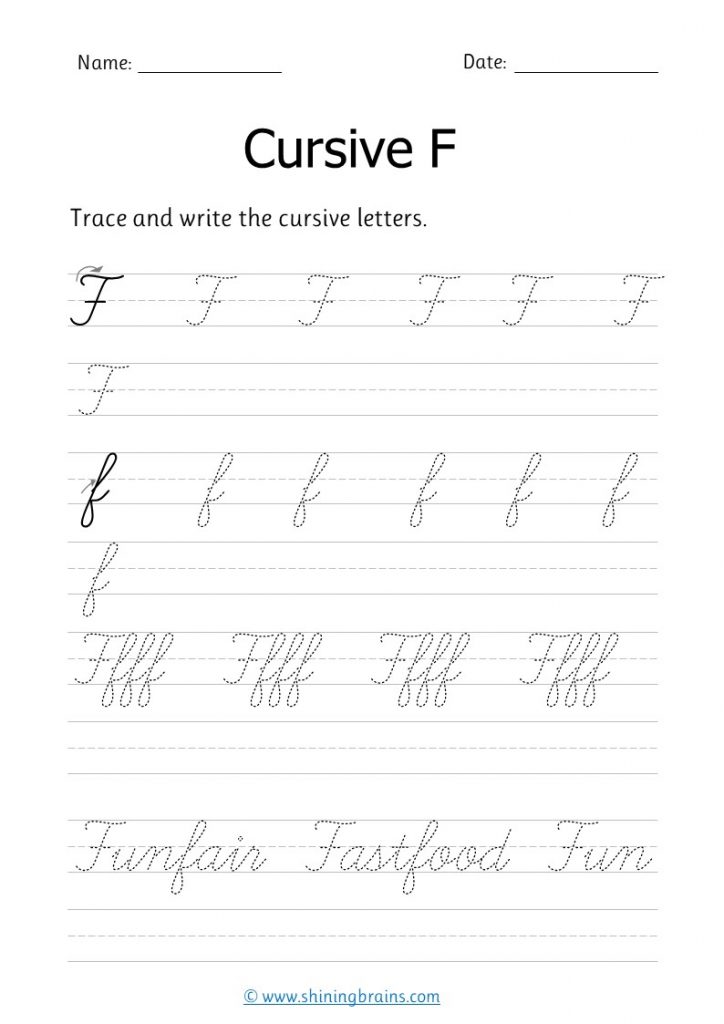
Mastering cursive lowercase letters requires a delicate balance of fluid motion, directional awareness, and spatial control. Among the alphabet, the letter f stands out as a unique challenge because it crosses both upper and lower spatial zones on standard writing lines. Educators often observe young learners hesitating at the top loop, unsure how to transition smoothly into the downward stroke before completing the exit tail. Introducing the free printable worksheet “cursive f” provides targeted practice designed to demystify this complex movement. When children engage with structured Letter Writing Worksheets, they transform abstract loops into confident, automatic handwriting habits. It sounds simple, and that’s the point: consistent exposure to isolated letter forms builds the muscle memory necessary for legible, connected text.
💡 Educational Key Takeaways:
- Core Skill: Structured Cursive F focused on developing pencil grip, stroke control, and early literacy/math confidence.
- Target Scope: Suited for homeschoolers, preschool, kindergarten, and elementary learners.
- Best Recommendation: Practice 10–15 minutes daily with ergonomic writing tools to reinforce muscle memory without hand fatigue.
What This Worksheet Covers
This specific practice sheet focuses entirely on the mechanics of forming the lowercase cursive f, guiding learners from initial tracing to independent execution. Children begin by analyzing directional arrows that demonstrate the precise starting point, the upward slant to the top line, the immediate downward loop extending below the baseline, and the finishing upward stroke. Following these directional cues helps prevent common reversals and improper stroke sequences that often plague developing writers. Furthermore, educators frequently notice that students who struggle with fluid transitions benefit immensely from repetitive, focused tracing exercises before moving on to full words. Alongside these writing drills, incorporating Tracing Worksheets into daily routines strengthens the foundational pencil control required for maintaining uniform slant and spacing across a full page.
Key Learning Outcomes
Working through this printout systematically yields measurable improvements in fine motor precision and letter legibility. Learners develop a deeper understanding of baseline orientation, ensuring that the lower loop dips correctly while the upper loop stays contained within the midline space. According to the American Occupational Therapy Association, mastering foundational pencil strokes and letter formations directly correlates with reduced hand fatigue and increased writing fluency during academic tasks. Additionally, children enhance their visual-motor integration as their eyes track the looping pencil path across the paper. This repetitive physical engagement transforms awkward hand movements into smooth, rhythmic gestures that support lifelong writing stamina.
How to Use This Worksheet
Implementation requires more than simply handing a pencil to a child and hoping for the best. Adults should first demonstrate the stroke in real-time, narrating the movement aloud while drawing an oversized version on a whiteboard or in the air. Learners then trace the faded gray examples using a sharp pencil, crayon, or colored marker to maintain high visual contrast. Here’s what makes this worksheet different: it incorporates graduated sizing, transitioning from large guided models to smaller, independent lines that challenge spatial boundaries. As accuracy improves, caregivers can pair these exercises with Name Practice Worksheets to keep the writing session engaging and personally relevant to the child.
Practical Tips for Parents and Teachers
Physical comfort plays a massive role in cursive success, so always check that the writing surface and chair match the child’s height, allowing both feet to rest flat on the floor. If a learner grips the pencil too tightly, encourage them to squeeze a small stress ball for a few seconds before writing to release tension in the hand muscles. Watch closely for proper paper tilt; cursive writing requires angling the paper slightly to match the natural outward arc of the child’s writing hand. Short, five-minute daily sessions yield far better retention than exhaustive, thirty-minute weekend marathons. Patience remains the most critical tool in the writing kit, as fluid muscle memory develops gradually through repeated, low-stress practice.
Age-Appropriate Recommendations
Introducing cursive instruction typically aligns with second or third grade, corresponding to specific developmental milestones outlined in the National Association for the Education of Young Children guidelines for developmentally appropriate practice. At this stage, children possess the intrinsic hand strength, bilateral coordination, and cognitive maturity required to understand continuous-stroke letter connections. Younger children in preschool or kindergarten are generally still refining basic pre-writing strokes and print awareness, making this specific cursive sheet best suited for ages seven through nine. For younger learners who are simply exploring early pencil manipulation, utilizing Preschool Worksheets provides a much more developmentally matched starting point before advancing to connected script.
Foundational pencil strokes and letter formations directly correlate with reduced hand fatigue and increased writing fluency — American Occupational Therapy Association
Frequently Asked Questions
How do adults access and print this file? Simply click the download link on the page to save the PDF file directly to a device, then print it out on standard letter-sized paper using any home or classroom printer. How does this specific practice support writing development? It builds essential muscle memory and spatial awareness by breaking down the complex multi-directional loops of the lowercase cursive f into manageable tracing steps. What age group is best suited for cursive instruction? According to the National Association for the Education of Young Children, cursive handwriting instruction is most effectively introduced in second grade when children have developed adequate fine motor control.
Explore More Free Printable Worksheets
Expanding a child’s writing repertoire requires access to a diverse library of skill-building resources. Educators and parents can browse an extensive collection of foundational Worksheets to support every stage of early childhood education. For moments when children need a break from traditional writing tools to build hand strength and focus, exploring various Coloring Worksheets offers an engaging, therapeutic alternative that prepares small hands for future academic tasks.
Developmental Milestone & Activity Table
| Development Stage | Recommended Daily Duration | Primary Learning Objective |
|---|---|---|
| Preschool & Pre-K | 10 – 15 Minutes | Pencil grip development & basic pre-stroke lines |
| Kindergarten | 15 – 20 Minutes | Letter/number formation & spatial line awareness |
| Early Elementary (Grade 1–2) | 20 – 30 Minutes | Fluency, sentence construction & neatness |
Images References