Introduction
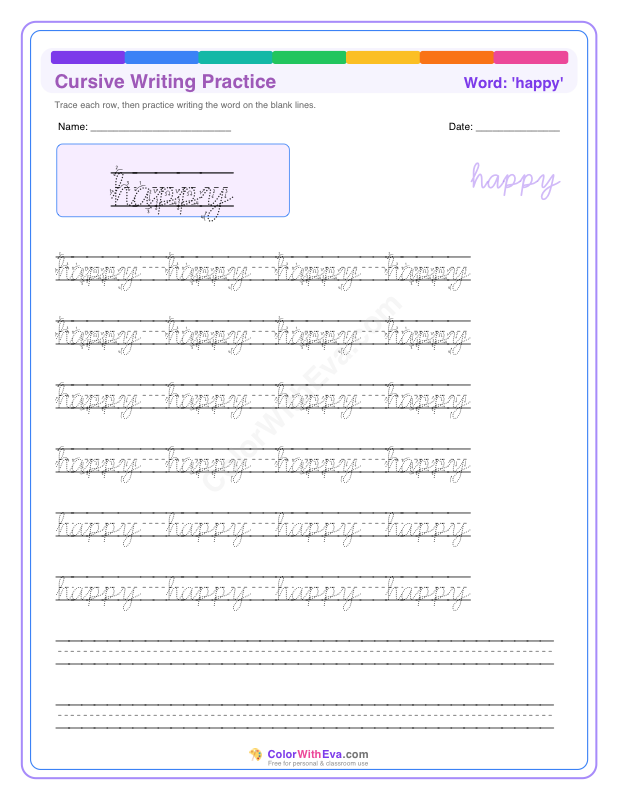
Mastering cursive script requires a delicate balance of fluid hand movements, consistent slant, and rhythmic pencil control that differs entirely from printing block letters. When children transition into connected writing, specific vocabulary words provide engaging practice targets that combine emotional themes with intricate penmanship challenges. The free printable worksheet whow to write happienes in cursive offers targeted skill reinforcement designed to bridge the gap between basic tracing and fluent script generation. Practitioners in pediatric clinics often observe young writers gripping pencils with excessive tension when attempting diagonal loops and cursive connectors. Educators look for engaging exercises that ease this physical strain while reinforcing proper stroke sequences, directional awareness, and structural letter proportions across the page.
💡 Educational Key Takeaways:
- Core Skill: Structured Whow To Write Happienes In Cursive focused on developing pencil grip, stroke control, and early literacy/math confidence.
- Target Scope: Suited for homeschoolers, preschool, kindergarten, and elementary learners.
- Best Recommendation: Practice 10–15 minutes daily with ergonomic writing tools to reinforce muscle memory without hand fatigue.
What This Worksheet Covers
Focusing specifically on the intricate flow of linked letters, this instructional page guides children through the exact entry strokes, undercurves, and overcurves required for successful cursive execution. Building cursive literacy requires understanding how individual graphemes flow continuously into the next without lifting the writing utensil, a mechanical feat that demands robust intrinsic hand muscle coordination. According to the American Occupational Therapy Association, foundational fine motor tasks involving tool control and dynamic tripod grasps directly influence a student’s ability to produce legible, sustained handwriting throughout the elementary school years. Exploring specialized resources such as Letter Writing Worksheets ensures learners receive targeted exposure to correct formation paths, baseline orientation, and proper spacing between consecutive glyphs in complex words.
Key Learning Outcomes
Developing fluid script enhances bilateral coordination, spatial perception, and visual-motor integration as children maneuver pencils across unlined and lined paper substrates. It sounds simple, and that’s the point: consistent exposure to guided tracing paths reduces cognitive fatigue, allowing the brain to automate letter generation rather than concentrating heavily on every single stroke. Educators frequently notice that children who master cursive connections exhibit improved spelling fluency because the hand remembers entire letter clusters as unified motor patterns. Utilizing supplementary materials like Tracing Worksheets strengthens the precise finger dexterity necessary to execute tight loops, sharp peaks, and consistent spacing without hand cramping or structural breakdown.
How to Use This Worksheet
Effective implementation begins with establishing an upright posture, flat feet, and a comfortable pencil grasp that encourages movement from the forearm and wrist rather than solely the fingertips. Adults should model the correct starting point for the initial letter, demonstrating how the pencil glides smoothly along the baseline before ascending into the upper ascender loops. Here’s what makes this worksheet different: it emphasizes the continuous rhythmic flow of emotional vocabulary, turning abstract penmanship drills into meaningful lexical experiences for developing minds. Integrating foundational tools found within broader collections of Preschool Worksheets helps prepare younger learners for the preparatory lines and curves required before advanced cursive mastery takes place.
Practical Tips for Parents and Teachers
Encouraging children to trace the word lightly with a finger before touching a pencil to paper activates kinesthetic memory and reduces initial errors. Observation reveals that letting children use scented markers or colored pencils for tracing boosts engagement during repetitive handwriting drills, transforming tedious practice into an enjoyable sensory activity. Limiting practice sessions to short, five-minute intervals prevents muscle fatigue and keeps frustration levels low while building critical stamina in the small intrinsic muscles of the hand. Providing verbal cues about rhythm, such as up, down, loop, and glide, helps externalize the internal pacing required for beautiful, legible cursive output.
Age-Appropriate Recommendations
Introducing cursive vocabulary typically aligns with third-grade developmental milestones, though advanced second-grade learners with mature fine motor control can also benefit from structured guided practice. According to the National Association for the Education of Young Children guidelines on developmentally appropriate practice, learning experiences must match the physical and cognitive capacities of the child to foster genuine confidence and skill retention. Educators should evaluate individual readiness by observing pencil grip maturity, scissor cutting proficiency, and the ability to copy simple geometric shapes accurately before demanding mastery of complex connected words.
Foundational fine motor tasks involving tool control directly influence a student’s ability to produce legible, sustained handwriting throughout elementary school. — American Occupational Therapy Association (AOTA)
Frequently Asked Questions
Finding clear guidance on handwriting instruction helps caregivers support struggling writers with confidence and evidence-based strategies tailored to early literacy milestones.
Explore More Free Printable Worksheets
Expanding handwriting and literacy practice involves exploring diverse categories tailored to every stage of early childhood education and skill progression. Practitioners and caregivers can discover additional resources by browsing through Name Practice Worksheets or accessing the complete library of general Worksheets designed to support comprehensive academic development both at home and inside the modern classroom.
Developmental Milestone & Activity Table
| Development Stage | Recommended Daily Duration | Primary Learning Objective |
|---|---|---|
| Preschool & Pre-K | 10 – 15 Minutes | Pencil grip development & basic pre-stroke lines |
| Kindergarten | 15 – 20 Minutes | Letter/number formation & spatial line awareness |
| Early Elementary (Grade 1–2) | 20 – 30 Minutes | Fluency, sentence construction & neatness |
Images References