Introduction
Bridging early mathematical concepts with foundational fine motor control requires creative resource design for young learners. When children encounter algebraic ideas like the powers of monomials and geometric applications, the cognitive load is already high. Adding physical writing demands can overwhelm developing hands unless educators provide structured, scaffolded practice materials. Occupational therapy and early childhood classrooms reveal a common challenge: learners grip pencils too tightly when facing unfamiliar math symbols, leading to rapid hand fatigue. Providing targeted resources from the broader collection of Worksheets helps mitigate this tension. This specific educational printout merges analytical thinking with precision pencil movement, ensuring that dexterity develops alongside spatial reasoning.
💡 Educational Key Takeaways:
- Core Skill: Structured Powers Of Monomials & Geometric Applications focused on developing pencil grip, stroke control, and early literacy/math confidence.
- Target Scope: Suited for homeschoolers, preschool, kindergarten, and elementary learners.
- Best Recommendation: Practice 10–15 minutes daily with ergonomic writing tools to reinforce muscle memory without hand fatigue.
What This Worksheet Covers
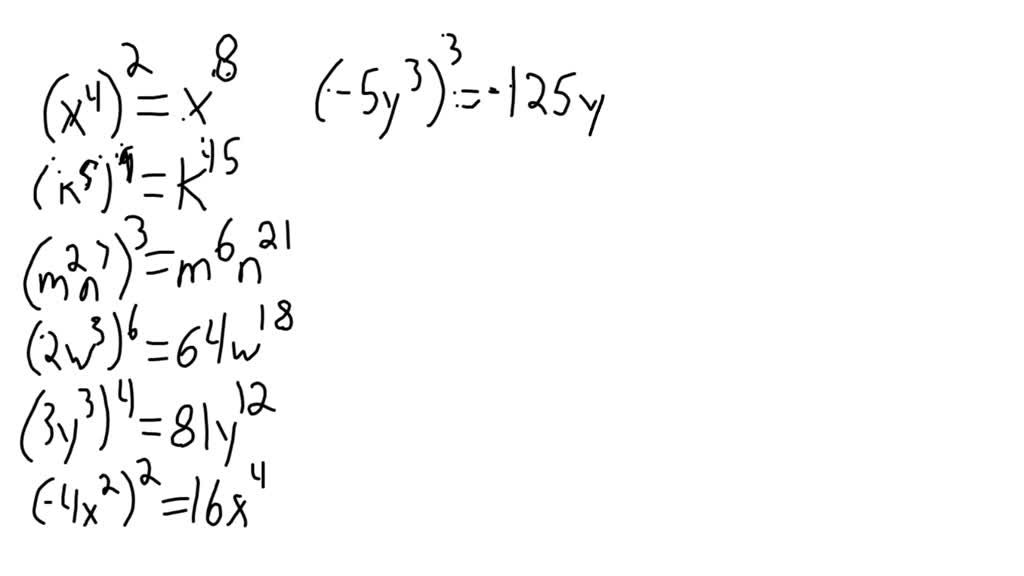
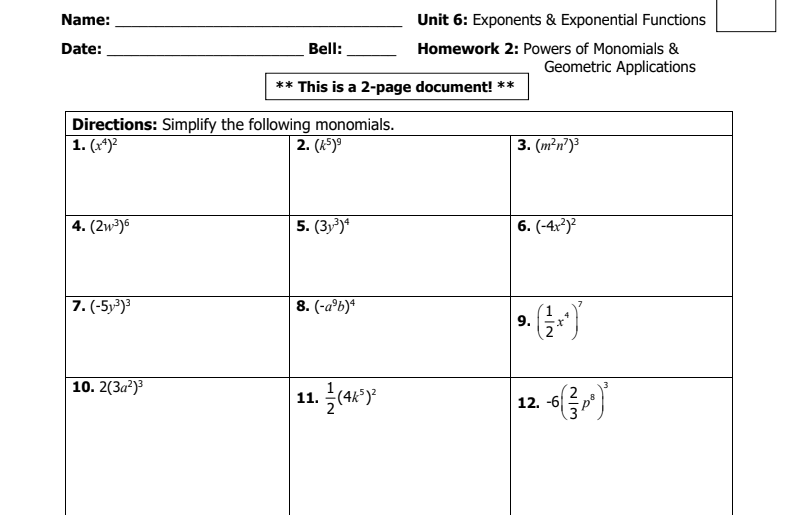
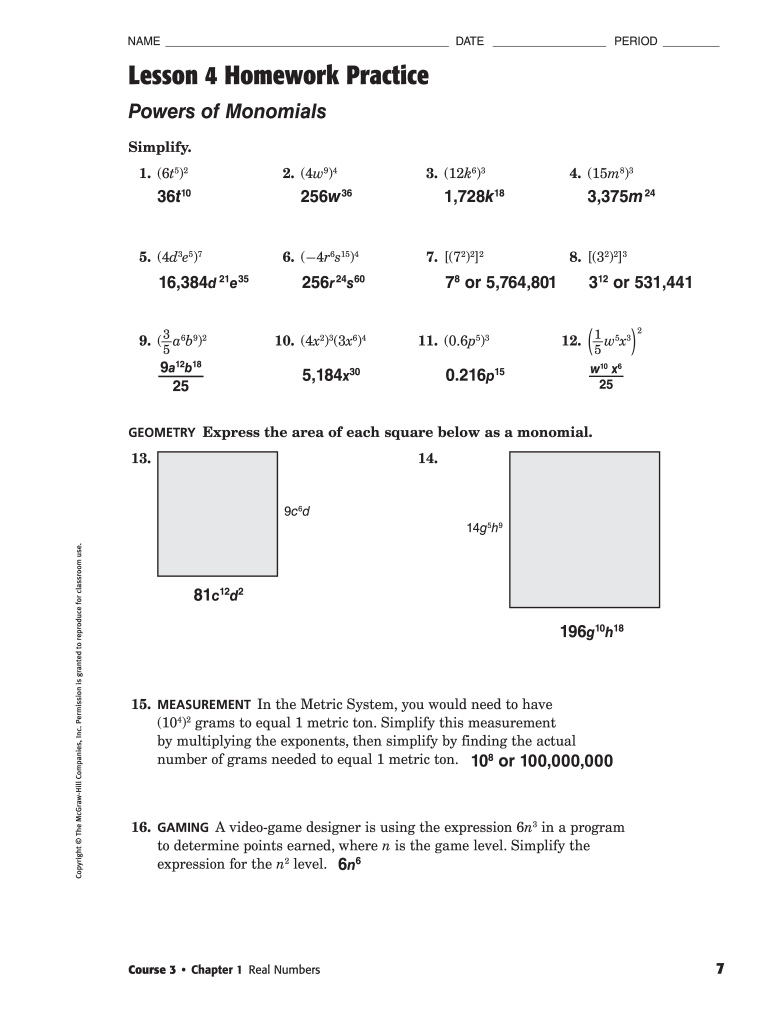
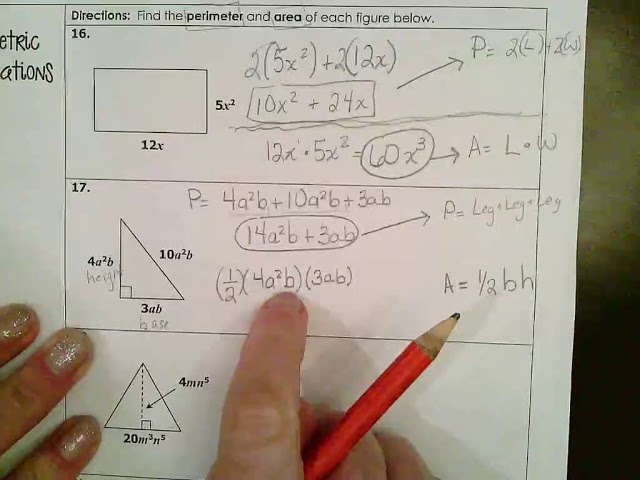
The instructional layout tackles the multiplication and powering of algebraic terms alongside visual area and perimeter calculations. Children navigate exponent rules while simultaneously refining the micro-movements required to form clean superscripts and geometric labels. According to the National Association for the Education of Young Children, integrating physical manipulation with conceptual problem-solving deepens memory retention in young minds. Learners must write variable coefficients, exponent values, and geometric dimensions within designated grid spaces. This spatial constraint demands rigorous visual-motor integration, pushing children to regulate pencil pressure as they draw shapes and write algebraic proofs.
Key Learning Outcomes
Mastering these exercises yields visible improvements in both mathematical fluency and hand control. Students learn to distinguish between base numbers and exponents while practicing the exact stroke sequences needed for tiny numerical notations. It sounds simple, and that’s the point: repeated exposure to writing compact mathematical notation builds intrinsic muscle memory in the hand’s intrinsic muscles. Educators frequently observe young learners struggling to keep superscripts proportional to base variables until they use structured grid lines. Over time, spatial awareness improves, allowing children to align multi-step geometric equations without drifting across the page.
How to Use This Worksheet
Implementation requires a balance of guided instruction and independent exploration. Adults should first review the foundational rules of exponents before handing out the printout, ensuring cognitive clarity before physical execution begins. Watch the grip as the child starts writing the first monomial expression. If fingers climb too close to the graphite tip, gentle redirection helps restore a dynamic tripod grasp. Pairing these math-focused pages with supplementary resources, such as specialized Tracing Worksheets, reinforces the baseline pencil control necessary for neat mathematical documentation.
Practical Tips for Parents and Teachers
Creating an ergonomic workspace dramatically improves output quality during rigorous problem-solving sessions. Ensure the chair allows feet to rest flat on the floor, establishing a stable physical base that prevents upper body fatigue. Slanting the writing surface using a simple binder or easel encourages a natural wrist extension, which is vital when writing tiny exponents. Encourage children to use a softer graphite pencil that requires less downward pressure, reducing hand cramping during extended geometric proofs. For learners transitioning from basic letter formation, exploring introductory exercises found within Preschool Worksheets can build foundational hand strength prior to tackling advanced algebraic notation.
Age-Appropriate Recommendations
Introducing algebraic concepts and geometric applications generally suits children in the upper end of the early childhood spectrum, typically ages seven to eight. According to the American Occupational Therapy Association, by age seven, children possess the hand arch development and finger differentiation required to execute precise, controlled strokes for small superscript numbers. Following the National Association for the Education of Young Children guidelines for developmentally appropriate practice, educators should tie these abstract equations to tangible, physical objects like counting blocks or tile area models. This multisensory bridge transforms daunting algebraic symbols into manageable, hands-on learning experiences.
Developmental Readiness — According to the American Occupational Therapy Association, refined finger differentiation and stable pencil grasps are fully consolidated by age eight, enabling children to manage complex visual-motor tasks like geometric labeling.
Frequently Asked Questions
Addressing common inquiries ensures seamless integration into daily learning environments at home or in the classroom.
Explore More Free Printable Worksheets
Expanding a child’s skill set requires a diverse library of learning materials tailored to different developmental milestones. Beyond algebraic practice, maintaining steady progress in handwriting requires specialized resources. Explore targeted practice options like dedicated Letter Writing Worksheets or customized Name Practice Worksheets to ensure comprehensive fine motor mastery across every subject area.
Developmental Milestone & Activity Table
| Development Stage | Recommended Daily Duration | Primary Learning Objective |
|---|---|---|
| Preschool & Pre-K | 10 – 15 Minutes | Pencil grip development & basic pre-stroke lines |
| Kindergarten | 15 – 20 Minutes | Letter/number formation & spatial line awareness |
| Early Elementary (Grade 1–2) | 20 – 30 Minutes | Fluency, sentence construction & neatness |
Images References