Introduction
Learning to connect letters in cursive represents a major milestone in a child’s writing journey. Transitioning from block printing to fluid, continuous lines requires a sophisticated blend of visual-motor integration and sustained postural control. Many young learners experience a sudden drop in legibility when first introduced to cursive scripts, simply because the physical demands change entirely. Targeted practice materials bridge this gap by offering controlled repetition without overwhelming the developing hand. Exploring foundational resources like Letter Writing Worksheets provides children with the structured exposure needed to master proper stroke sequences. Adults often notice a child’s grip tightening excessively during these early cursive attempts, signaling the need for deliberate, scaffolded practice rather than rushed completion.
💡 Educational Key Takeaways:
- Core Skill: Structured Cursive Writing Dad focused on developing pencil grip, stroke control, and early literacy/math confidence.
- Target Scope: Suited for homeschoolers, preschool, kindergarten, and elementary learners.
- Best Recommendation: Practice 10–15 minutes daily with ergonomic writing tools to reinforce muscle memory without hand fatigue.
What This Worksheet Covers
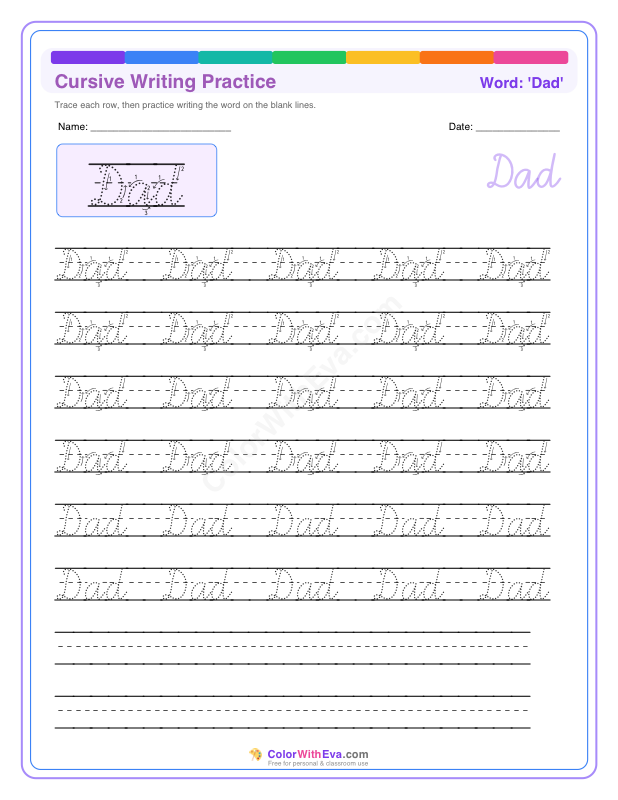
The free printable worksheet “cursive writing dad” focuses specifically on mastering the fluid connections required for this three-letter familial word. Children encounter the looping ascender of the letter ‘d’, the rounded body of the ‘a’, and the final connecting stroke leading into the second ‘d’. Such targeted vocabulary prevents cognitive overload, allowing the brain to prioritize muscle memory over spelling retention. According to Reading Rockets, explicit instruction in letter formation directly supports fluency by reducing the cognitive load associated with basic mechanics. It sounds simple, and that’s the point. By isolating a short, highly familiar word, learners build confidence in continuous stroke production before tackling longer, more complex sentences.
Key Learning Outcomes
Mastery of this specific printable yields measurable improvements in pencil control and spatial awareness across the page. Children learn to maintain consistent slant, uniform letter height, and appropriate spacing between distinct words. Occupational therapy clinics frequently observe that children who struggle with fluid transitions benefit immensely from practicing short, repetitive letter combinations like the ones featured here. For broader foundational skill development, pairing this exercise with Tracing Worksheets helps reinforce baseline hand-eye coordination. Furthermore, successfully completing the word fosters a tangible sense of accomplishment, encouraging young writers to approach subsequent handwriting challenges with positive anticipation and reduced muscle fatigue.
How to Use This Worksheet
Implementing this printable effectively requires an environment that prioritizes ergonomic posture and proper writing tools. Ensure the child’s feet rest flat on the floor, hips and knees bent at ninety-degree angles, with the paper slightly tilted to match the natural slant of the writing arm. Adults should model the correct continuous motion first, drawing a finger through the air before putting pencil to paper. Here’s what makes this worksheet different: it emphasizes the rhythmic flow of joining strokes rather than isolated static shapes. Learners trace the faded gray models multiple times to build kinetic memory before attempting independent execution on the blank primary lines provided at the bottom of the page.
Practical Tips for Parents and Teachers
Short, frequent practice sessions yield significantly better neurological retention than infrequent, marathon writing drills. Limit direct instruction to five or ten minutes per day to prevent hand cramping and mental fatigue in early elementary students. If a child begins dropping their wrist below the writing line—a common compensatory habit—gently reposition the hand and introduce a vertical writing surface like an easel to encourage a natural wrist extension. Incorporating a variety of multi-sensory activities, such as practicing the word in colored sand or shaving cream, solidifies the kinetic pattern before returning to traditional paper. For educators seeking supplementary vocabulary building, integrating exercises from Name Practice Worksheets keeps the curriculum engaging and personal.
Age-Appropriate Recommendations
Introducing cursive typically aligns with second or third grade, corresponding roughly to the Handwriting Without Tears developmental continuum for lowercase letter connections and rhythm. At age seven or eight, children possess the intrinsic hand strength and refined intrinsic muscle control necessary to maintain consistent pressure throughout a continuous word string. According to the American Occupational Therapy Association, handwriting readiness depends heavily on the maturation of the hand’s arches and established hand dominance. For younger children in preschool or kindergarten who show early readiness, introducing simpler foundational exercises via Preschool Worksheets establishes the baseline stability required for later cursive success.
Proficient handwriting instruction requires direct, explicit modeling of letter formation combined with consistent multi-sensory practice to ensure automaticity. — American Occupational Therapy Association (AOTA)
Frequently Asked Questions
How do educators download and print this cursive writing resource? Users simply click the download link on the main page to save the PDF file directly to a computer or mobile device for immediate home or classroom printing. Does this specific worksheet improve fine motor control? Yes, tracing and executing continuous cursive strokes refines bilateral hand coordination, finger dexterity, and visual-motor integration essential for neat writing. What do developmental organizations say about handwriting practice? According to the American Occupational Therapy Association, regular handwriting practice enhances neurological pathways responsible for reading fluency, spelling retention, and overall academic confidence.
Explore More Free Printable Worksheets
Expanding a child’s writing toolkit requires access to a diverse array of practice materials tailored to every developmental stage. Exploring the comprehensive catalog of Worksheets ensures that parents, teachers, and homeschoolers always find targeted activities for pencil grip, letter formation, and creative expression. Additionally, incorporating creative mediums like Coloring Worksheets offers a fantastic, low-pressure way to build enduring hand strength and visual focus outside of structured writing time.
Developmental Milestone & Activity Table
| Development Stage | Recommended Daily Duration | Primary Learning Objective |
|---|---|---|
| Preschool & Pre-K | 10 – 15 Minutes | Pencil grip development & basic pre-stroke lines |
| Kindergarten | 15 – 20 Minutes | Letter/number formation & spatial line awareness |
| Early Elementary (Grade 1–2) | 20 – 30 Minutes | Fluency, sentence construction & neatness |
Images References