Introduction
Mastering a new script requires patience, precise visual-motor integration, and consistent foundational practice. When children begin exploring bilingual literacy or heritage languages, learning a distinct orthographic system like the Serbian Cyrillic alphabet presents unique neurological and motor demands. Every single loop, vertical stroke, and acute angle requires deliberate pencil control, transforming standard literacy tasks into complex physical maneuvers. Educators often observe young learners holding their breath as they navigate the intricate curves of characters like ‘б’ or ‘ж’, demonstrating just how much physical effort goes into early script acquisition. Providing structured guidance during these initial attempts ensures that children build both accurate letter formation and lasting confidence without hand fatigue.
💡 Educational Key Takeaways:
- Core Skill: Structured Handwritten Serbian Cyrillic Alphabet focused on developing pencil grip, stroke control, and early literacy/math confidence.
- Target Scope: Suited for homeschoolers, preschool, kindergarten, and elementary learners.
- Best Recommendation: Practice 10–15 minutes daily with ergonomic writing tools to reinforce muscle memory without hand fatigue.
What This Worksheet Covers
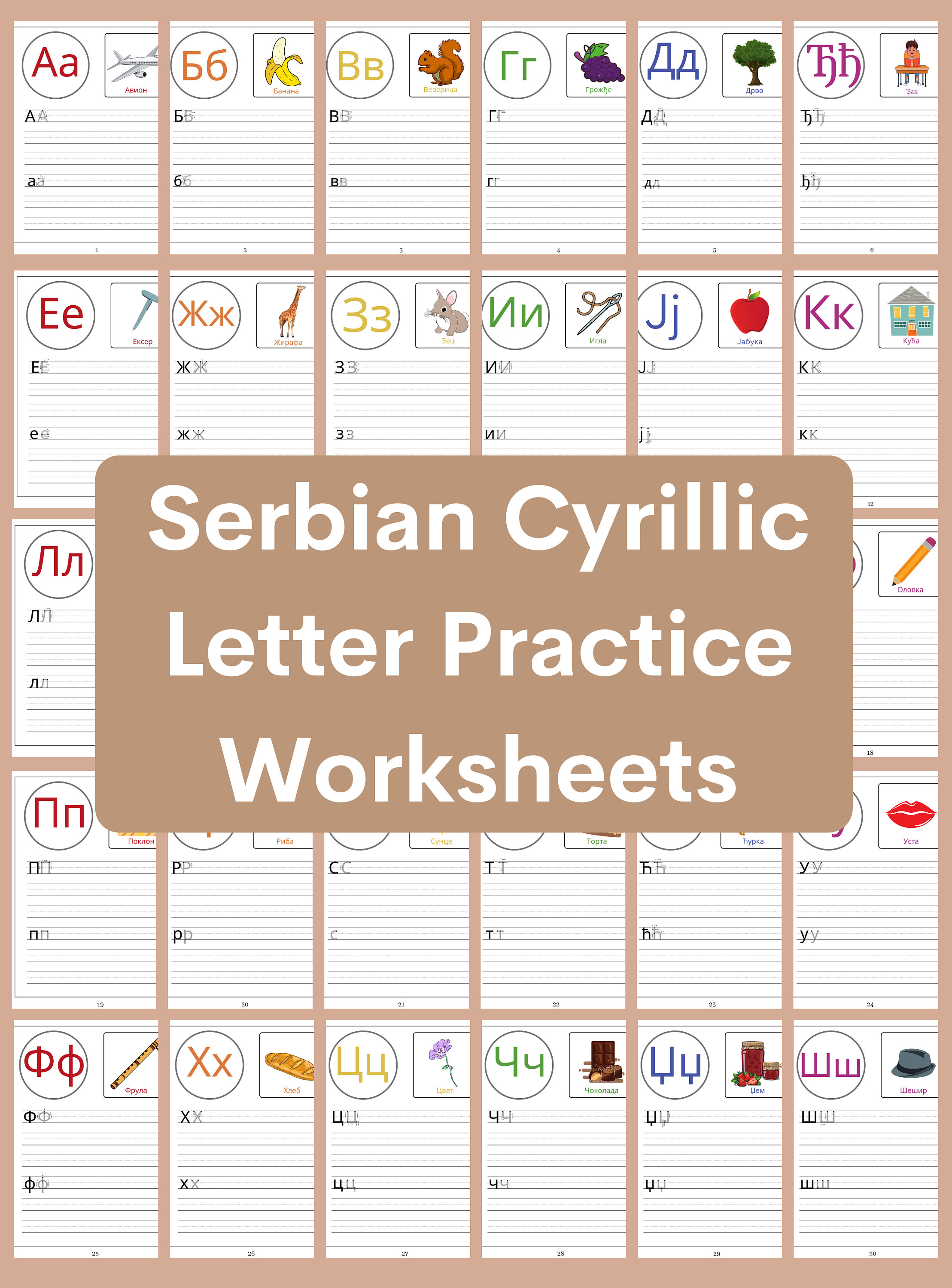
The free printable worksheet centered on the handwritten Serbian Cyrillic alphabet systematically guides children through both the 30 uppercase and lowercase letterforms. It sounds simple, and that’s the point: structured repetition bridges the gap between visual recognition and physical execution. By isolating individual letter strokes, the layout reduces cognitive overload so the nervous system can focus strictly on motor planning and spatial orientation on the page. Alongside targeted Letter Writing Worksheets, this resource addresses the exact directional pulls and proportions unique to Cyrillic handwriting standards. Children practice moving from simple vertical baselines to complex looped connectors, establishing proper muscle memory before bad habits take root.
Key Learning Outcomes
Targeted execution of these distinct characters directly reinforces bilateral coordination, visual closure, and fine motor precision. Children learn to maintain uniform letter sizing, respect baseline boundaries, and execute correct stroke sequences without excessive hand pressure. According to the American Occupational Therapy Association, foundational fine motor control established through structured writing practice significantly predicts long-term academic success and handwriting fluency. Consistent engagement with these specialized templates also enhances orthographic mapping, allowing young brains to rapidly link unfamiliar visual symbols to their corresponding phonetic sounds in both Cyrillic and broader Preschool Worksheets contexts.
How to Use This Worksheet
Successful implementation begins with posture and writing tool selection rather than immediately diving into full alphabet rows. Adults should ensure the child’s feet rest flat on the floor, hips and knees bend at ninety-degree angles, and the non-dominant hand stabilizes the paper. Here’s what makes this worksheet different: it allows for modular pacing, meaning adults can isolate specific troublesome characters rather than demanding the entire alphabet at once. Children benefit greatly from tracing tactile models first, perhaps using a finger in the air or over a textured printout, before applying graphite to paper. Complementary activities found within broader Tracing Worksheets collections can further reinforce the pre-writing curves necessary for fluid Cyrillic execution.
Practical Tips for Parents and Teachers
Short, frequent practice sessions yield exponentially better results than marathon writing drills that trigger hand cramping and frustration. Keep sessions under ten minutes, stopping the moment hand fatigue or loss of focus becomes apparent. Therapists frequently notice that children slump or shift their grip entirely when an activity drags on too long, signaling that the intrinsic hand muscles need a break. Using broken crayons or short pencils naturally encourages an efficient tripod grasp by physically preventing over-fisting. Always praise the precision of a single well-formed loop rather than rushing toward completion of an entire page.
Age-Appropriate Recommendations
Introducing a secondary script requires careful alignment with developmental stages, typically spanning ages five through eight. According to the National Association for the Education of Young Children Developmentally Appropriate Practice guidelines, instructional tasks must align with children’s current motor capabilities and cognitive readiness. Five-year-olds should focus primarily on large-scale formation, finger tracing, and mastering basic pre-writing strokes before tackling complex Cyrillic characters. By ages six and seven, children possess the necessary visual-motor integration to refine letter proportions and maintain consistent spacing within structured lines. Eight-year-olds can utilize these resources for speed refinement, orthographic transition fluency, and self-correction during independent writing tasks.
Foundational fine motor control established through structured writing practice significantly predicts long-term academic success and handwriting fluency. — American Occupational Therapy Association
Frequently Asked Questions
Answers to common inquiries regarding implementation, printing, and developmental benefits provide clarity for adults guiding young writers.
Mastering letter formation supports overall cognitive development by integrating visual perception with precise physical execution. — Centers for Disease Control and Prevention
Explore More Free Printable Worksheets
Expanding a child’s writing toolkit requires access to diverse resources that target different facets of pencil control and literacy. Adults can browse additional Worksheets designed to build comprehensive pre-handwriting skills across various themes and formats. Combining alphabet tracking with creative Coloring Worksheets ensures that children maintain high engagement while continuously strengthening their hand muscles.
Developmental Milestone & Activity Table
| Development Stage | Recommended Daily Duration | Primary Learning Objective |
|---|---|---|
| Preschool & Pre-K | 10 – 15 Minutes | Pencil grip development & basic pre-stroke lines |
| Kindergarten | 15 – 20 Minutes | Letter/number formation & spatial line awareness |
| Early Elementary (Grade 1–2) | 20 – 30 Minutes | Fluency, sentence construction & neatness |
Images References