Introduction
Developing foundational literacy and fine motor control requires targeted practice that bridges the gap between basic letter recognition and active writing production. Many children struggle not with remembering the alphabet, but with the physical act of isolating specific sounds and manipulating a writing tool to record them inside confined spaces. Practitioners often observe young learners staring at a partial word, knowing the missing sound orally yet stumbling when translating that auditory awareness into a controlled pencil stroke. The free printable write the middle letters worksheet bridges this exact developmental gap by targeting internal phonetic awareness while simultaneously demanding precise hand-eye coordination. It sounds simple, and that is precisely the point. By focusing exclusively on the medial sound of simple CVC words, this resource removes visual clutter and allows the developing brain to concentrate fully on phoneme-grapheme mapping and pencil control. Exploring early academic foundations often begins with specialized Letter Writing Worksheets designed to reinforce proper stroke habits from the very first classroom session.
💡 Educational Key Takeaways:
- Core Skill: Structured Write The Middle Letters Worksheet focused on developing pencil grip, stroke control, and early literacy/math confidence.
- Target Scope: Suited for homeschoolers, preschool, kindergarten, and elementary learners.
- Best Recommendation: Practice 10–15 minutes daily with ergonomic writing tools to reinforce muscle memory without hand fatigue.
What This Worksheet Covers
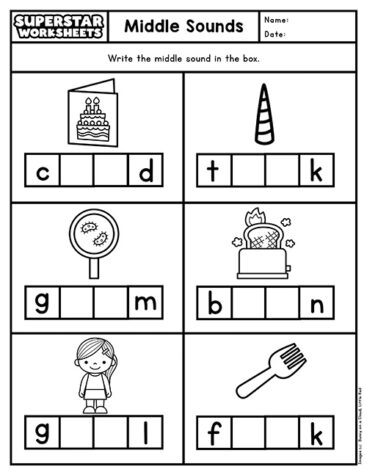
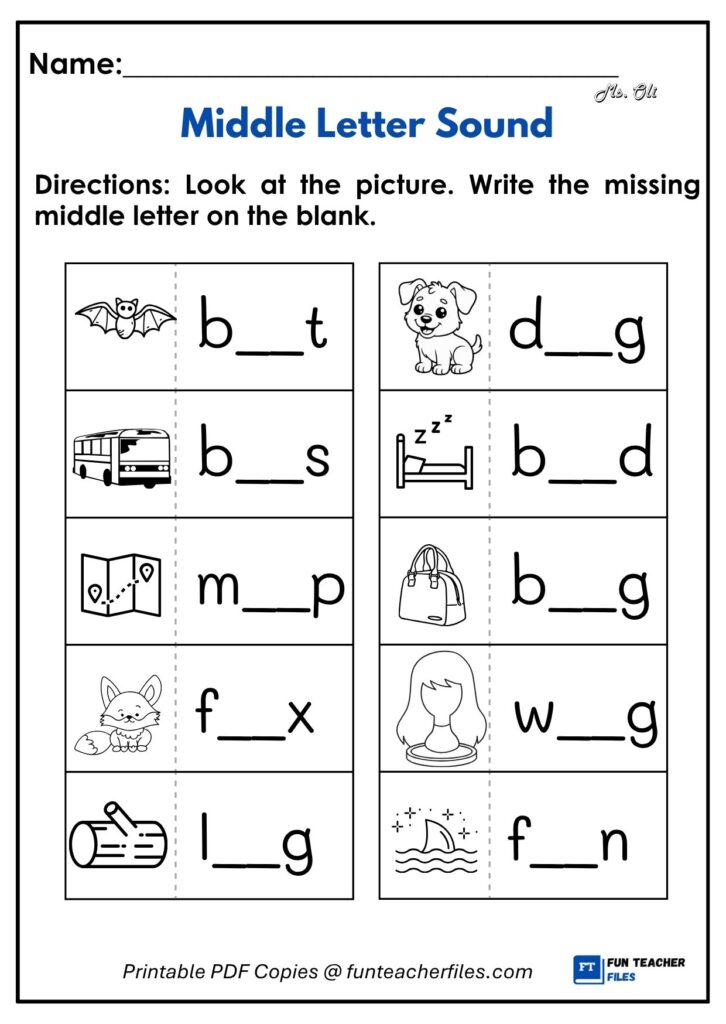
Targeting medial sounds requires a unique cognitive shift because children naturally anchor onto initial and final consonants when decoding spoken language. The write the middle letters worksheet presents familiar pictorial prompts accompanied by three-letter words missing their vital center vowel, challenging the learner to supply the correct missing character. Children must first name the object, stretch the vowel sound aloud to isolate the middle phoneme, select the matching grapheme, and finally execute the physical handwriting mechanics required to render that letter cleanly on the page. According to Reading Rockets, systematic phonics instruction paired with targeted handwriting practice significantly improves early reading fluency and spelling accuracy in young children. This multi-step cognitive process strengthens neural pathways between auditory processing centers and motor planning regions in the cerebral cortex. Far beyond a mere spelling exercise, the format acts as a comprehensive diagnostic tool for educators monitoring phonological awareness alongside physical dexterity.
Key Learning Outcomes
Executing this targeted print resource yields measurable progress across several interconnected developmental domains essential for primary school success. Learners systematically improve their short vowel discrimination, avoiding common confusion between similar sounds like short ‘e’ and short ‘i’. Concurrently, the physical requirement to write letters within designated boxes or primary lines refines spatial awareness and visual-motor integration. According to the American Occupational Therapy Association, mastering pencil control during early childhood lays the vital groundwork for legible, fatigue-free writing throughout later academic years. Children also build foundational confidence as they successfully decode and complete each word independently. Expanding a child’s foundational toolkit benefits greatly from incorporating diverse Preschool Worksheets that target varied tactile and cognitive milestones simultaneously.
How to Use This Worksheet
Maximizing the educational value of this resource involves more than simply handing a child a pencil and pointing to the first item. Adults should begin by having the learner say the name of the depicted object out loud, stretching the middle sound dramatically to help the ear capture the vowel. Demonstrating how to form the target letter on a separate whiteboard before writing on the printable helps prevent frustration and incorrect stroke habits. Children benefit immensely from using tactile supports, such as tracing over a textured outline or writing the missing letter in a small tray of sand before putting graphite to paper. Integrating broader developmental resources, such as comprehensive Worksheets, ensures children receive a well-rounded educational experience across multiple developmental categories.
Practical Tips for Parents and Teachers
Classroom observations reveal that children frequently rush through medial vowel exercises because visual attention naturally gravitates toward the start and end of words. To counteract this tendency, educators and parents can use a small sticky note to cover the first and last letters, forcing absolute focus onto the blank center space. Writing utensils matter deeply during these formative practice sessions; switching to short, unsharpened golf pencils naturally encourages a proper tripod grasp by eliminating extra barrel length that tempts a fist grip. Breaking the worksheet into smaller chunks—perhaps tackling only three words at a single sitting—prevents hand fatigue and keeps frustration levels low. Pairing literacy tasks with targeted Tracing Worksheets further strengthens the foundational wrist and finger movements required for sustained writing endurance.
Age-Appropriate Recommendations
Aligning this printable resource with established developmental milestones ensures that children are neither overwhelmed by excessive demands nor bored by under-challenging tasks. According to Common Core ELA standard RF.K.2.D, kindergarten students are expected to isolate and pronounce the initial, medial vowel, and final sounds in three-phoneme CVC words. Therefore, this worksheet fits best in the latter half of kindergarten or as an advanced challenge for older preschoolers who have already mastered basic letter-sound correspondence. Children at the younger end of this spectrum may require adult verbal scaffolding and larger writing lines to accommodate developing fine motor precision. Recognizing these precise developmental markers helps adults tailor the learning environment to suit each individual child’s unique pace of maturation.
Systematic phonics instruction combined with targeted handwriting practice significantly boosts early spelling retention — Reading Rockets
Frequently Asked Questions
Understanding the mechanics and distribution of these educational printables helps adults implement them effectively in both home and school environments. Below are answers to the most common questions regarding format, usage, and developmental alignment.
Explore More Free Printable Worksheets
Continuing a child’s educational journey requires access to a diverse array of supplementary practice materials tailored to specific developmental needs. Exploring curated collections allows educators and families to target distinct fine motor and literacy objectives without interruption. Additional resources span from foundational pre-writing strokes to advanced vocabulary building exercises, ensuring every learner finds appropriate challenges. Discovering these comprehensive print options empowers adults to create dynamic, individualized learning pathways for children aged two through eight.
Developmental Milestone & Activity Table
| Development Stage | Recommended Daily Duration | Primary Learning Objective |
|---|---|---|
| Preschool & Pre-K | 10 – 15 Minutes | Pencil grip development & basic pre-stroke lines |
| Kindergarten | 15 – 20 Minutes | Letter/number formation & spatial line awareness |
| Early Elementary (Grade 1–2) | 20 – 30 Minutes | Fluency, sentence construction & neatness |
Images References