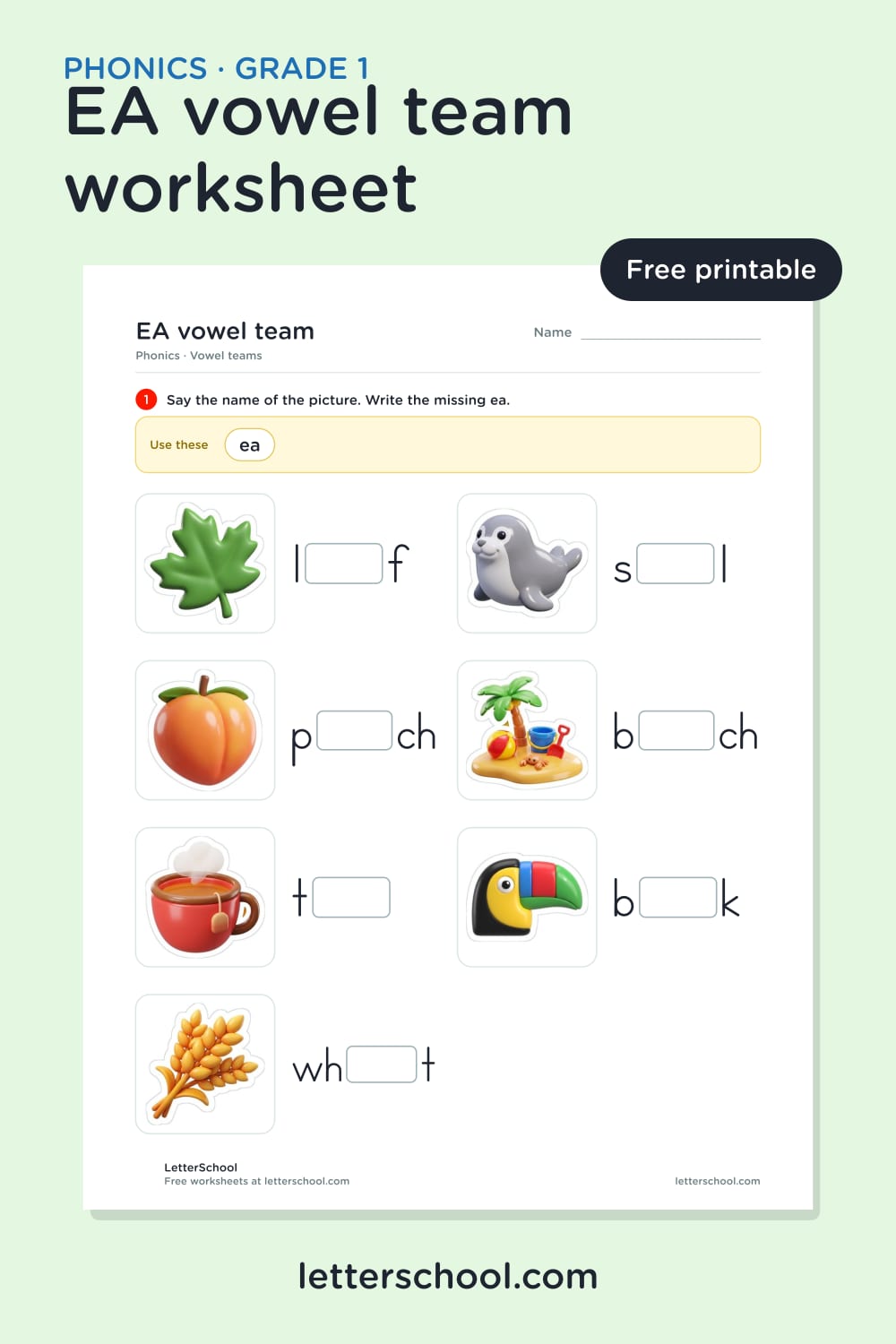
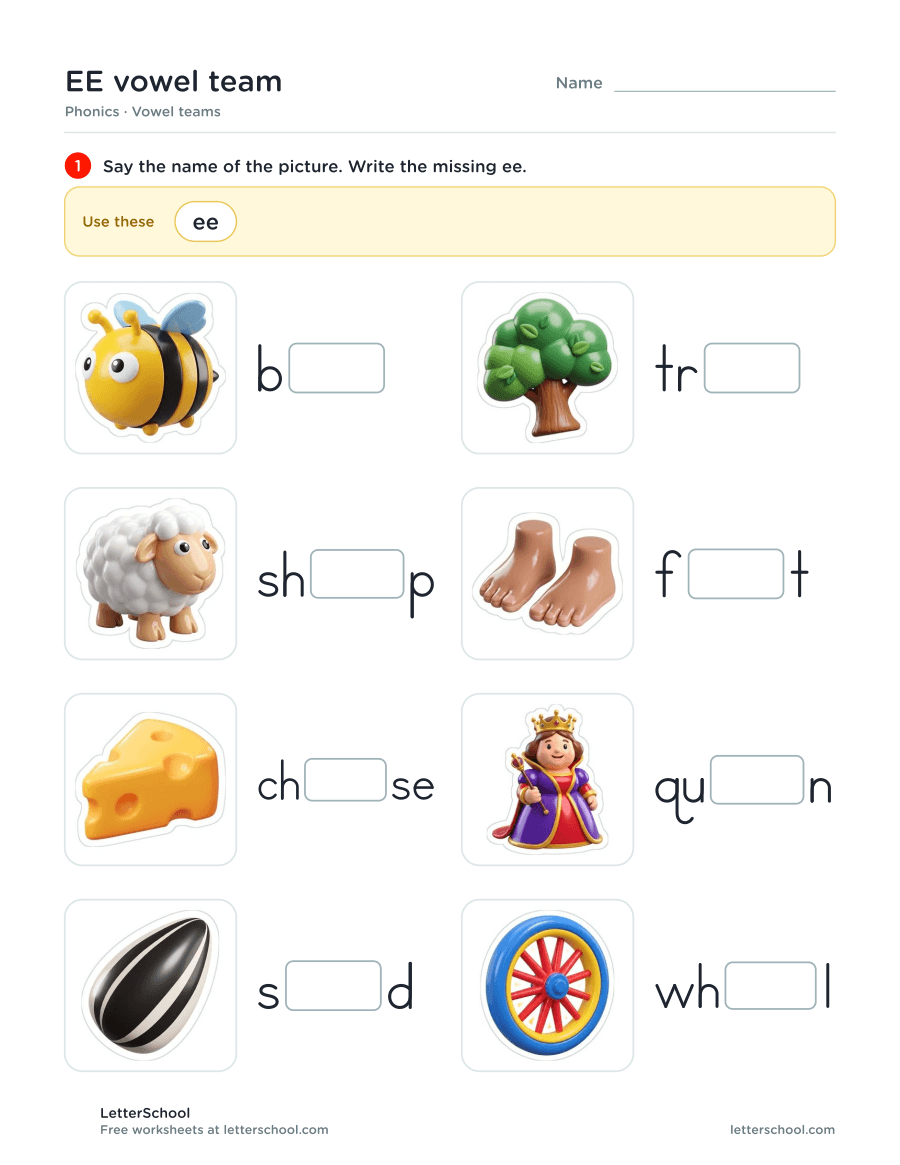
Introduction
A writing letter ee worksheet provides targeted graphic scaffolding and kinesthetic muscle memory reinforcement required for children to master the formation of lowercase and uppercase vowel graphemes. According to the National Association for the Education of Young Children (NAEYC), systematic early childhood writing instruction directly enhances phonetic decoding, letter recognition speed, and fine-motor control. Integrating foundational letter writing worksheets into daily literacy routines bridges the gap between abstract phonemes and concrete orthographic symbols. Educators frequently combine these resources with structured tracing worksheets to build pencil grip endurance before independent freehand writing begins.
Handwriting Practice Snapshot:
- Core Focus: A writing letter ee worksheet isolates double-vowel stroke mechanics and spacing accuracy.
- Target Scope: Early elementary students and preschoolers developing foundational print awareness.
- Key Recommendation: Pair repetitive tactile tracing with verbal stroke descriptions to secure cognitive mapping.
Core Principles and Detailed Overview
Letter formation mechanics depend heavily on continuous directional flow, spatial orientation, and baseline adherence. A high-quality writing letter ee worksheet incorporates dotted midline grids, directional arrows, and start-stop dots that guide the hand through the correct sequence. The lowercase letter ‘e’ requires a short horizontal pull to the right, a counter-clockwise curve up to the top line, and a smooth sweep down to the baseline, repeated twice for the digraph ‘ee’. Proper kinetic execution prevents common reversion habits and reduces hand fatigue during extended writing sessions. Young learners transition smoothly from introductory preschool worksheets into advanced orthographic drills once pencil pressure regulation stabilizes.
Key Specifications and Breakdown
| Skill Level / Grade | Target Stroke / Mechanical Focus | Pedagogical / Coaching Cue |
|---|---|---|
| Preschool / Pre-K | Gross motor continuity and directional left-to-right tracking | Pull across the middle, curve up and around, scoop underneath. |
| Kindergarten | Baseline alignment and uniform letter height consistency | Keep both circles touching the baseline without floating upward. |
| 1st Grade & Beyond | Fluid digraph spacing and automaticity in spelling patterns | Connect the twin letters smoothly without lifting the pencil tip. |
Developmental Progression Principle — American Occupational Therapy Association (AOTA)
Step-by-Step Practical Application and Guidelines
Executing a writing letter ee worksheet effectively requires a structured progression from sensory tracing to independent freehand production. Instructors should first demonstrate the stroke sequence on a large vertical surface to engage shoulder and elbow stability before transitioning the child to flat desk work. Learners begin by tracing textured outlines with index fingers, progress to thick-marker pencil tracing over dotted guidelines, and finally practice unassisted generation on primary lined paper. Educators seeking comprehensive skill expansion frequently supplement core handwriting drills with targeted name practice worksheets and visual-motor coloring worksheets to sustain engagement.
Common Challenges and How to Avoid Them
Children frequently struggle with closing the loop of the letter ‘e’ or collapsing the twin digraph into an illegible scribble due to undeveloped intrinsic hand muscles. To correct looping failures, instructors should enforce a strict start-in-the-middle rule rather than beginning at the baseline. Positioning the worksheet at a slight slant matching the child’s forearm angle prevents awkward wrist bending and eliminates visual distortion. Monitoring pencil grasp frequency ensures that maladaptive finger-wrapping habits do not impede fluid hand movement across the page.
💬 Frequently Asked Questions
Explore More Free Handwriting and Character Worksheets
Mastering fundamental literacy skills requires a robust library of structured printable resources tailored to every developmental stage. Explore the complete collection of free educational materials and printable worksheets available across the main portal to support lifelong writing proficiency at CharacterWritingWorksheets.com.
Worksheet Previews & Reference Materials