Introduction
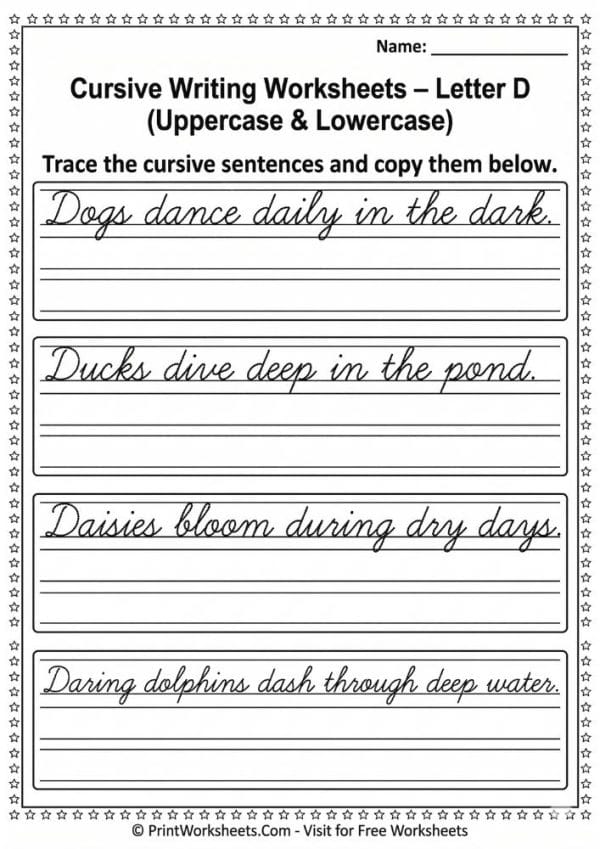
Cursive writing letter d worksheets provide targeted fine-motor practice sheets designed to master the specific counter-clockwise clock-stroke, ascender loop, and exit connector required for fluent lowercase and uppercase letter formation. According to the American Occupational Therapy Association (AOTA), explicit handwriting instruction utilizing structured stroke sequences significantly enhances manual dexterity, spatial organization, and orthographic mapping in early elementary students. Mastering this specific character requires precise pencil control, transitioning smoothly from foundational tracing worksheets to independent lined execution. Educators and parents deploy these specialized resources to bridge the gap between basic motor control and legible, connected cursive scripting.
Handwriting Practice Snapshot:
- Core Focus: Systematic stroke sequencing for lowercase and uppercase cursive letter d.
- Target Scope: Early elementary classrooms, remedial occupational therapy, and homeschool environments.
- Key Recommendation: Combine tactile tracing drills with lined repetition to build lasting muscle memory.
Core Principles and Detailed Overview
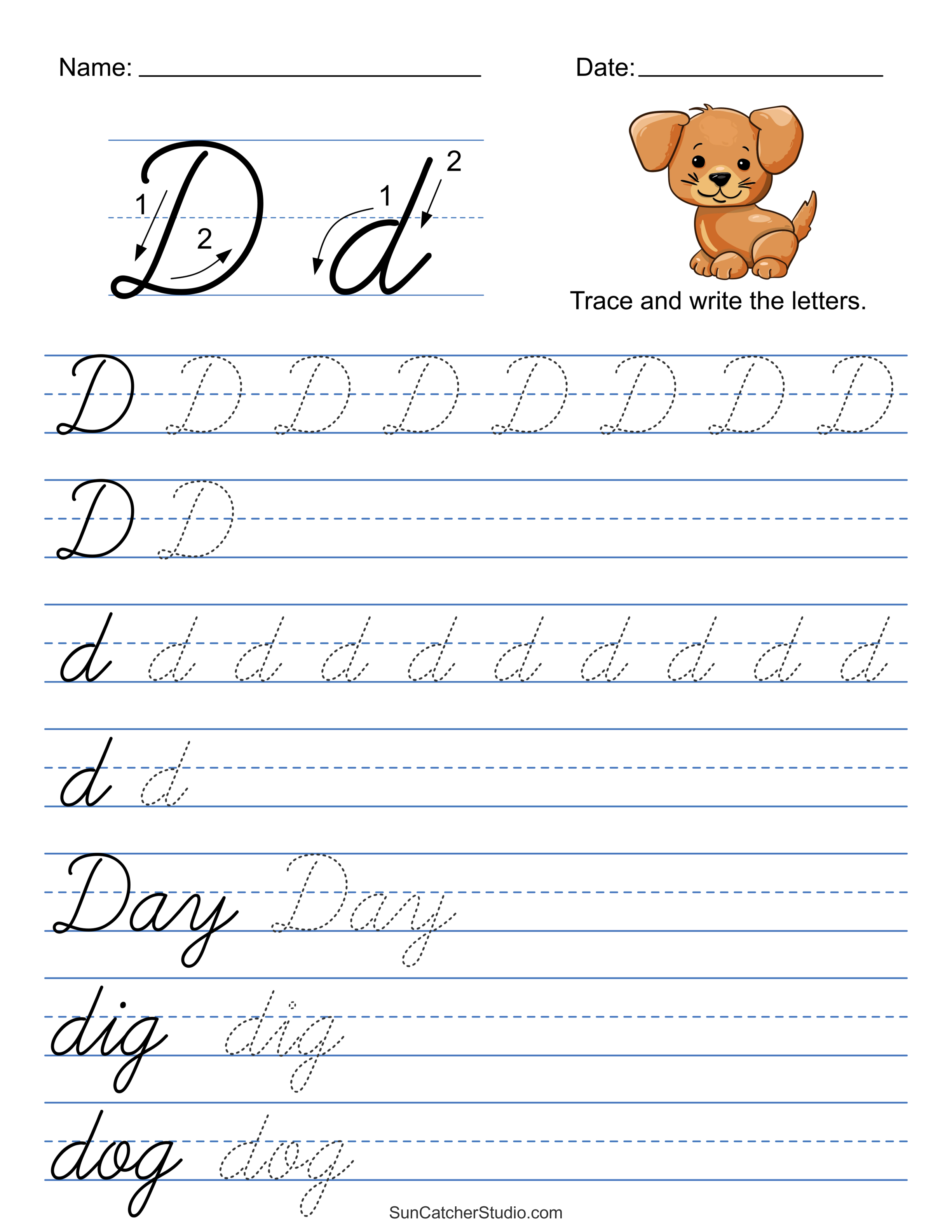
Cursive writing letter d worksheets establish mechanical permanence by isolating the complex directional changes inherent in loop-based scripts. The lowercase cursive ‘d’ demands a retraced starting stroke identical to the letter ‘a’, followed by an upward extension reaching the mid-line or top ascender line, and concluding with a horizontal exit stroke that prepares the hand for subsequent letter integration. When paired with comprehensive letter writing worksheets, these pages reinforce fluid momentum rather than isolated, disjointed pen lifts. Proper baseline alignment, consistent slant angles (typically 55 degrees from the horizontal), and measured loop widths form the triad of successful cursive mastery.
Key Specifications and Breakdown
| Skill Level / Grade | Target Stroke / Mechanical Focus | Pedagogical / Coaching Cue |
|---|---|---|
| Grade 2 (Beginner) | Clock-stroke oval formation and baseline retracing | “Trace around the clock, close the circle, push straight up, and pull right back down.” |
| Grade 3 (Intermediate) | Ascender loop height consistency and exit connector spacing | “Reach the middle line, loop neatly, and keep the exit stroke flat on the floor line.” |
| Grade 4+ (Advanced) | Connecting cursive ‘d’ to challenging letters like ‘e’, ‘r’, and ‘o’ | “Bridge the connector smoothly without lifting the pencil tip off the writing surface.” |
Explicit instruction in sequential letter formation and kinesthetic pencil control directly correlates with improved reading fluency and cognitive orthographic processing. — American Occupational Therapy Association (AOTA). Related guide: Free Letter Print Printable Stencils.
Step-by-Step Practical Application and Guidelines
Executing cursive writing letter d worksheets effectively requires moving sequentially from large-motor air-writing to fine-motor paper implementation. Begin by having learners trace oversized models with a finger to internalize the directional flow, progressing immediately to thick-grip writing utensils on lined paper. Educators should emphasize posture—feet flat on the floor and paper tilted at a comfortable angle matching the student’s writing hand. Practitioners must regularly audit student hand positioning to ensure fingers remain approximately one inch below the writing tip, preventing visual obstruction and hand fatigue during extended writing blocks.
Common Challenges and How to Avoid Them
The most frequent obstacle encountered on cursive writing letter d worksheets is the accidental transformation of the letter ‘d’ into a ‘cl’ cluster or a malformed ‘a’ due to incomplete ascender loops. Instructors can diagnose this error by checking whether the student stops at the baseline before pushing upward; if the pencil lifts prematurely, the loop collapses. Supplementing daily penmanship practice with structured preschool worksheets or engaging coloring worksheets can help remediate underlying grip strength and spatial boundary awareness before advancing to complex cursive connections.
💬 Frequently Asked Questions
Explore More Free Handwriting and Character Worksheets
Enhance daily instructional planning by exploring the comprehensive collection of customizable handwriting resources available across the site, including specialized name practice worksheets and foundational worksheets. Visit CharacterWritingWorksheets.com today to download printable assets designed to elevate early literacy and motor skills.
Worksheet Previews & Reference Materials