Introduction
Preschool and early elementary learners often stare at a cursive letter, then fumble with the strokes needed to bring it to life. Most children can recognize letters long before their fine motor skills catch up to form them correctly. According to the National Center for Learning Disabilities, 75% of children with dyslexia experience difficulty with handwriting, underscoring the importance of early, targeted practice. The “letter f in cursive” worksheet offers a structured, printable avenue for building that essential muscle memory, turning abstract symbols into confident penmanship. Printable resources remain a staple in classrooms and homes because they provide tactile engagement, immediate feedback, and a repeatable format that supports steady skill acquisition.
💡 Educational Key Takeaways:
- Core Skill: Structured Letter F In Cursive focused on developing pencil grip, stroke control, and early literacy/math confidence.
- Target Scope: Suited for homeschoolers, preschool, kindergarten, and elementary learners.
- Best Recommendation: Practice 10–15 minutes daily with ergonomic writing tools to reinforce muscle memory without hand fatigue.
What This Worksheet Covers
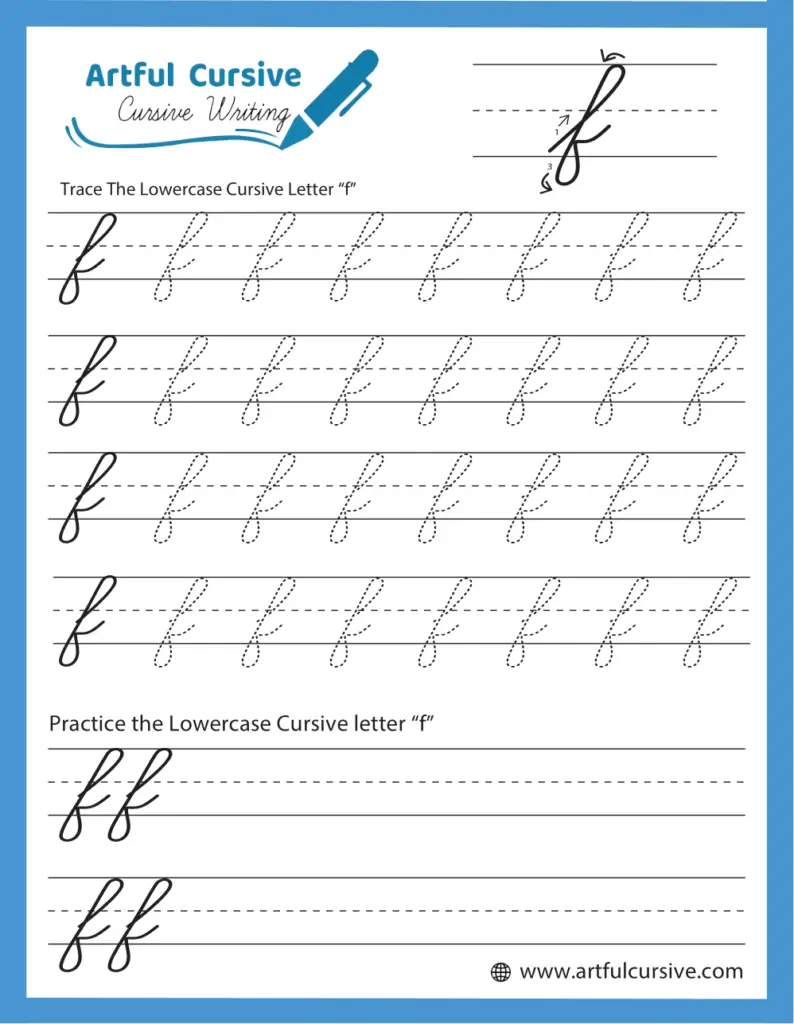
This printable focuses exclusively on the lowercase cursive “f,” guiding learners through the proper start, loop, and finish of the character. By tracing guided lines, children internalize the slanted baseline and the gentle upward curve that distinguishes cursive from print. The activity aligns with early literacy benchmarks that call for consistent letter formation, ensuring that practice meets the expectations of both developmental and academic standards. The design incorporates spaced rows for repeated attempts, allowing each stroke to build on the previous one, while a subtle directional arrow hints at the proper flow of movement.
Key Learning Outcomes
Completing this worksheet helps learners refine the fine‑motor coordination needed to grip a pencil and execute smooth strokes. It also strengthens visual‑motor integration, as children match the shape they see with the shape they produce. Language development benefits, too, because mastering the cursive “f” paves the way for writing simple words such as “fun” and “fly.” Confidence in written expression grows when each traced letter feels successful, encouraging a willingness to tackle longer sentences. Finally, repeated exposure to the same letter reinforces neural pathways that support reading fluency and spelling accuracy.
How to Use This Worksheet
The worksheet presents a series of faint “f” outlines followed by blank lines for independent tracing. Each row begins with a model, then offers a space for the learner to copy the shape, and finishes with a larger box for freehand practice. Teachers can distribute the sheet during morning work time, as part of a handwriting center, or as a take‑home activity for families. The format works equally well on a dry‑erase board, allowing a quick review before handing out the printed copy. Because the sheet is printable, it can be reproduced for small groups, whole‑class instruction, or individualized remediation.
Practical Tips for Parents and Teachers
Modeling the correct pencil grip before a child begins ensures that the hand is positioned for smooth motion; a tripod hold with the thumb and index finger lightly resting on the pencil yields the best control. After the worksheet is completed, a brief conversation about the sound that “f” makes—perhaps linking it to a favorite storybook character—adds a phonemic layer to the visual practice. Pairing the sheet with a read‑aloud that features many “f” words, such as “Frog Goes to School,” reinforces the connection between letter shape and language. Displaying finished pages on a classroom wall creates a gallery of progress that children can revisit, solidifying retention. For learners who finish quickly, extending the activity with a short sentence writing task—like “The fox jumps”—provides an appropriate challenge.
Age-Appropriate Recommendations
For ages 3–5, the worksheet should be introduced with generous adult support. A caregiver can use a thick‑capped crayon to help develop hand strength, then transition to a short‑shank pencil once the child shows readiness. The NAEYC Developmentally Appropriate Practice framework recommends integrating fine‑motor activities into daily routines, so a brief 5‑minute tracing session fits naturally into circle time or a snack break. For ages 6–10, the same sheet becomes a component of a larger cursive unit that meets Common Core State Standards for ELA, specifically CCSS.ELA-LITERACY.RF.K.1, which calls for recognizing and naming upper‑ and lowercase letters. At this stage, learners can handle a standard #2 pencil, and the teacher can provide occasional corrective feedback while encouraging independent repetition. Connecting the “f” practice to journal writing or spelling lists helps embed the skill within authentic literacy tasks.
Frequently Asked Questions
Q: How can the free worksheet be downloaded and printed?
A: The worksheet is available on the CharacterWritingWorksheets.com site; selecting the “Download PDF” button provides an instant file that can be printed on any standard printer. A single sheet prints on one side of an 8.5×11‑inch page, making it easy to produce multiple copies for a classroom or home setting.
Q: Why does tracing improve early literacy development?
A: Tracing reinforces the visual shape of a letter while simultaneously engaging the motor pathways needed for writing. Research highlighted by Reading Rockets shows that coordinated visual‑motor practice supports phonemic awareness and spelling, laying a foundation for fluent reading.
Q: Is the “letter f in cursive” worksheet suitable for children with fine‑motor challenges?
A: Yes; the sheet’s large, lightly printed guides allow for slower, more deliberate movements, and the spaced rows give ample room for error correction. Handwriting Without Tears recommends using such progressive tracing tools to scaffold skill development for learners who need additional support.
Explore More Free Printable Writing Worksheets
Using a single “letter f in cursive” sheet is most effective when it becomes part of a consistent, progressive writing practice routine. A steady sequence of character worksheets—covering every letter, number, and symbol—helps young writers develop a complete repertoire of print and cursive skills. Educators, homeschool parents, and caregivers are invited to explore the full library of free printable character writing worksheets, letter formation practice pages, tracing sheets, and early writing activities at CharacterWritingWorksheets.com. The collection is organized by age, skill level, and theme, ensuring that each learner can find resources that match their current stage and future goals.
Letter F In Cursive – Image Gallery
Developmental Milestone & Activity Table
| Development Stage | Recommended Daily Duration | Primary Learning Objective |
|---|---|---|
| Preschool & Pre-K | 10 – 15 Minutes | Pencil grip development & basic pre-stroke lines |
| Kindergarten | 15 – 20 Minutes | Letter/number formation & spatial line awareness |
| Early Elementary (Grade 1–2) | 20 – 30 Minutes | Fluency, sentence construction & neatness |
Images References