Introduction
Handwriting milestones often appear after children already know the shapes of letters, creating a moment when confidence meets fine‑motor challenge. Most children can recognize letters long before their fine motor skills catch up to form them correctly, and that gap can feel frustrating for both learners and adults. According to the National Center for Learning Disabilities, 1 in 5 children have a learning disability that can affect handwriting, underscoring the importance of early, supportive practice. The “ethan cursive” worksheet steps in as a structured, printable resource that bridges recognition and production through guided tracing and repeated exposure. Printable worksheets remain a trusted tool in classrooms because they offer tactile, low‑tech reinforcement that aligns with developmental sequencing. This resource was designed with the same clarity and purpose that a first‑grade teacher expects when selecting daily writing practice materials.
💡 Educational Key Takeaways:
- Core Skill: Structured Ethan Cursive focused on developing pencil grip, stroke control, and early literacy/math confidence.
- Target Scope: Suited for homeschoolers, preschool, kindergarten, and elementary learners.
- Best Recommendation: Practice 10–15 minutes daily with ergonomic writing tools to reinforce muscle memory without hand fatigue.
What This Worksheet Covers
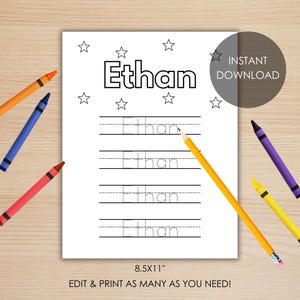
The “ethan cursive” sheet targets the lowercase cursive formation of the name “ethan,” allowing learners to practice each stroke in a consistent, repeatable pattern. Each line presents a faint guide, followed by a bold model that children can trace, reinforcing the loop‑and‑tail movements essential to cursive fluency. The activity aligns with early literacy standards that call for mastery of letter shapes before moving to free‑hand writing, ensuring that practice is not isolated but tied to broader curriculum expectations. By focusing on a single, meaningful word rather than isolated letters, the worksheet supports both motor sequencing and word‑level familiarity, a combination that research shows enhances retention.
Key Learning Outcomes
Completing the “ethan cursive” page helps children develop a smoother pencil grip, a prerequisite for legible script. The repeated motion of tracing each letter reinforces muscle memory, allowing the brain to store the motor pattern for later recall. At the same time, exposure to a familiar name connects handwriting practice to personal relevance, encouraging motivation and a sense of ownership over the written product. Finally, the activity nurtures visual‑motor integration, a skill that research links to later reading comprehension and overall academic achievement.
How to Use This Worksheet
Educators can introduce the sheet during a morning work routine, beginning with a brief demonstration of the correct pencil hold and the direction of each stroke. The worksheet’s layout includes a series of tracing lines, a bold cursive model, and a blank space where the learner attempts independent writing. It works equally well as a stand‑alone activity or as part of a larger handwriting unit that incorporates warm‑up exercises, fine‑motor games, and alphabet review. When used in a writing center, the sheet can be paired with a timer to encourage focused practice without overwhelming the child. For home use, the printable can be printed on standard 8.5×11‑inch paper and placed beside a comfortable workspace, allowing parents to supervise without taking over the task.
Practical Tips for Parents and Teachers
Modeling the pencil grip before a child begins helps establish the foundation for smooth strokes; a tripod hold with the thumb and index finger guiding the pencil yields the most control. After the worksheet is completed, discuss each letter’s unique curve, turning the practice session into a mini‑lesson on letter anatomy. Pairing the activity with a read‑aloud book that features the name “Ethan” reinforces the connection between spoken language and written form. Displaying finished pages on a classroom wall or a home bulletin board provides visual reinforcement and celebrates effort. For children who struggle, offering a larger‑lined version of the sheet or a thicker writing instrument can reduce frustration, while early finishers might be challenged to write the name in free‑hand cursive or embed it in a short sentence.
Age-Appropriate Recommendations
For preschoolers ages 3–5, the worksheet should be introduced with abundant adult scaffolding. At this stage, fine‑motor readiness is still emerging; a chunky crayon or a triangular‑shaped pencil grip can make the tracing motion easier. Short, frequent sessions—five minutes two to three times a day—keep attention high and prevent fatigue. The NAEYC Developmentally Appropriate Practice guidelines recommend integrating writing activities into play, so pairing the worksheet with a naming game (e.g., “Find the ‘e’ in the room”) deepens relevance. For early elementary learners ages 6–10, the same sheet can be used more independently. A standard #2 pencil supports the finer pressure control required for cursive flow. According to the Common Core State Standards for ELA (CCSS.ELA-Literacy.RF.1.3), students at this level should be able to read and write familiar words, making “ethan” an ideal bridge between decoding and production. Teachers might assign the worksheet as part of a weekly handwriting journal, allowing students to track progress over time while meeting curriculum expectations.
Frequently Asked Questions
Q: How can the “ethan cursive” worksheet be downloaded and printed?
A: The worksheet is available as a free PDF on the CharacterWritingWorksheets.com site; simply click the download button, open the file, and print on standard printer paper. No special software is required beyond a basic PDF viewer.
Q: Why does tracing help early literacy development?
A: Tracing reinforces the visual shape of letters while simultaneously building the fine‑motor pathways needed for independent writing. According to Reading Rockets, repeated handwriting practice supports phonemic awareness and spelling skills, creating a stronger foundation for reading.
Q: Can this worksheet be used with children who have a learning disability?
A: Yes; the resource aligns with Handwriting Without Tears recommendations for differentiated instruction, offering clear visual models and ample spacing for error correction. Adjustments such as larger lines or thicker writing tools can be made to meet individual needs.
Explore More Free Printable Writing Worksheets
Integrating “ethan cursive” into a consistent writing routine maximizes its impact, but a single sheet shines brightest when part of a sequenced collection. A broader library of character‑specific worksheets, number tracing pages, and themed writing prompts supports progressive skill development from preschool through third grade. Educators, homeschool parents, and caregivers are invited to explore the full range of free printable resources at CharacterWritingWorksheets.com, where every letter, number, and character type is thoughtfully designed for diverse learning environments. Continued practice nurtures confidence, precision, and a lifelong love of writing.
Ethan Cursive – Image Gallery
Developmental Milestone & Activity Table
| Development Stage | Recommended Daily Duration | Primary Learning Objective |
|---|---|---|
| Preschool & Pre-K | 10 – 15 Minutes | Pencil grip development & basic pre-stroke lines |
| Kindergarten | 15 – 20 Minutes | Letter/number formation & spatial line awareness |
| Early Elementary (Grade 1–2) | 20 – 30 Minutes | Fluency, sentence construction & neatness |
Images References