Introduction
Most children can recognize letters long before their fine motor skills catch up to form them correctly, and the transition from recognition to production often feels like a milestone. According to the National Center for Learning Disabilities, about 20 % of school‑age children experience handwriting difficulties that affect academic performance. The printable worksheet titled “cursive capital f” bridges that gap by offering structured tracing, guided practice, and visual cues that support the development of a smooth, legible capital “F” in cursive. Printable resources remain a staple in classrooms because they provide a tactile, repeatable experience that digital screens cannot replicate. This worksheet is designed to sit comfortably on a desk, a homeschool table, or a classroom writing center, inviting learners to practice the same shape multiple times until confidence grows. Explore more in our worksheets collection.
💡 Educational Key Takeaways:
- Core Skill: Structured Cursive Capital F focused on developing pencil grip, stroke control, and early literacy/math confidence.
- Target Scope: Suited for homeschoolers, preschool, kindergarten, and elementary learners.
- Best Recommendation: Practice 10–15 minutes daily with ergonomic writing tools to reinforce muscle memory without hand fatigue.
What This Worksheet Covers
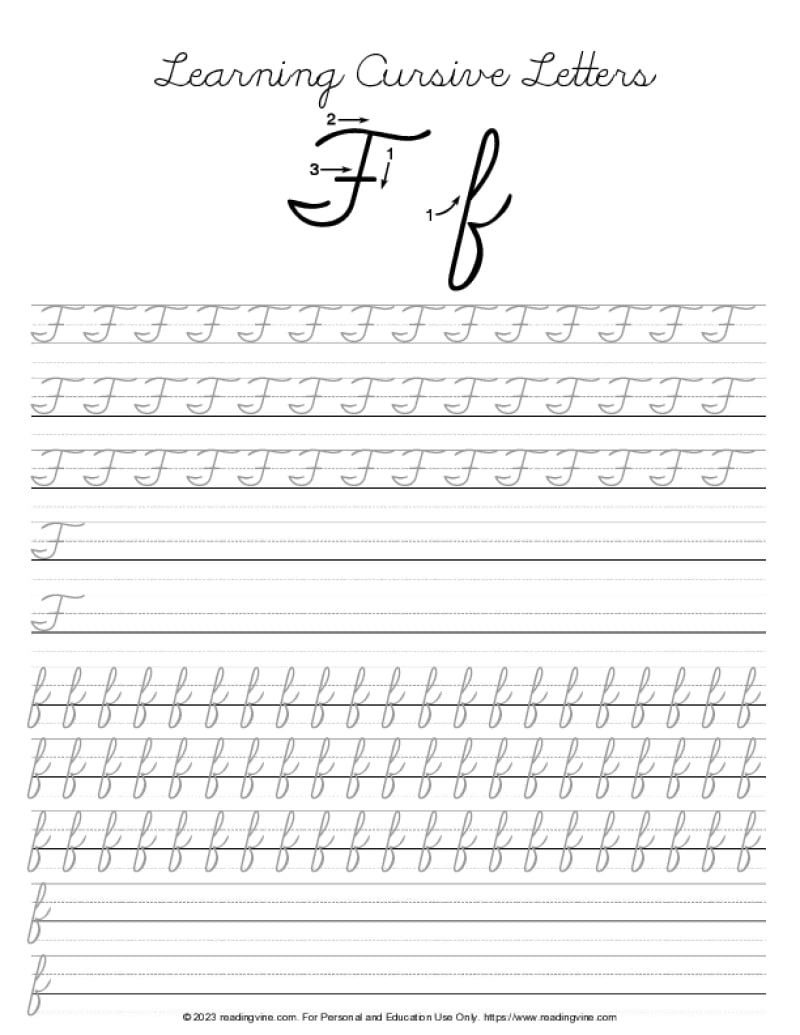
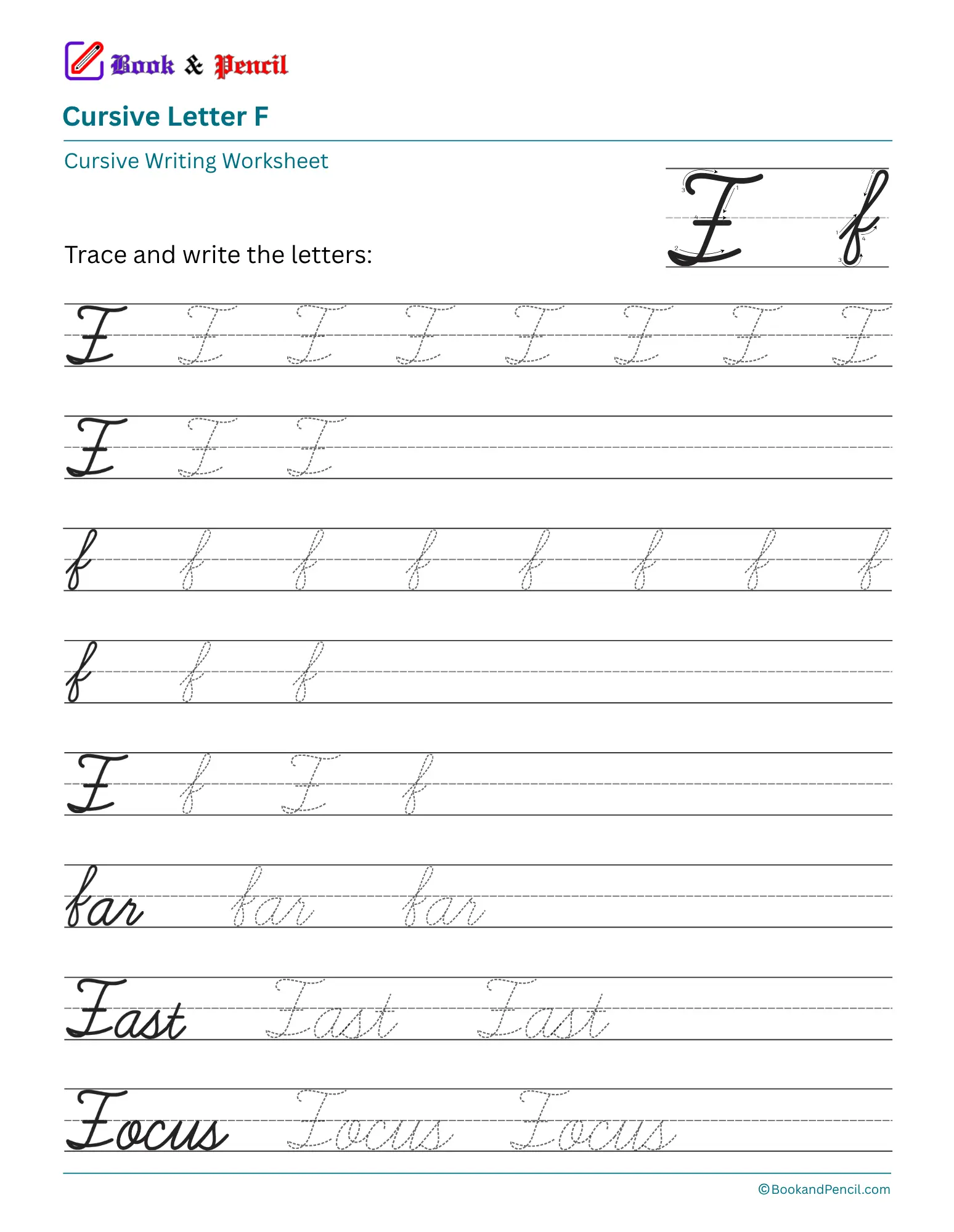
The focus of this resource is the formation of the uppercase cursive letter F, a character that appears frequently in names, titles, and early reading material. Activities guide learners through the proper start point, upward stroke, and descending loop, aligning with the Handwriting Without Tears principles that emphasize consistent motion and ergonomic pencil grip. By tracing the letter in a series of progressively lighter lines, children internalize the motor pattern while simultaneously reinforcing visual memory. The worksheet’s design also meets Common Core State Standards for ELA, which call for mastery of print conventions and legible handwriting by the end of first grade. Here’s what makes this worksheet different: each step is scaffolded, allowing the learner to move from assisted tracing to independent writing without feeling overwhelmed.
Key Learning Outcomes
Completing the “cursive capital f” sheet builds fine‑motor coordination as the small muscles in the hand learn to control pressure and direction. It also strengthens visual‑motor integration, a skill that underpins both reading fluency and spelling accuracy. As learners repeat the strokes, they develop a sense of proportion, ensuring the top loop aligns with the baseline and the descender reaches the appropriate length. Confidence in forming a single capital letter lays the groundwork for writing whole words, so this activity indirectly supports early spelling and composition. It sounds simple — and that’s the point. The cumulative effect is a smoother transition to more complex cursive writing tasks later in the year.
How to Use This Worksheet
The sheet presents a series of faint guide lines, a bold model of the cursive capital F, and lighter tracing rows that gradually fade, encouraging independent practice. Teachers can hand out copies during a morning work period, place them in a writing center for self‑directed use, or assign them as a take‑home reinforcement activity. Parents may print the sheet for a quiet after‑school session, pairing it with a short story that features the letter “F” prominently. That’s exactly what this resource addresses: flexibility for both structured classroom instruction and informal home practice. The worksheet can stand alone or become part of a larger unit on cursive alphabet mastery, linking directly to daily handwriting drills.
Practical Tips for Parents and Teachers
Modeling the correct pencil grip before the child begins tracing helps establish a comfortable posture that reduces fatigue. After the worksheet is completed, a brief conversation about the sound and shape of the letter “F” can turn a motor activity into a literacy moment, especially when connected to words like “frog” or “friend.” Pairing the practice with a read‑aloud that highlights the target letter reinforces both visual and auditory pathways, making the shape more memorable. Displaying finished pages on a classroom wall or a home bulletin board provides a visual reminder and celebrates progress. For learners who finish quickly, extending the activity with a short writing prompt—such as “Write three words that start with F”—keeps the momentum going.
Age-Appropriate Recommendations
For preschoolers ages 3–5, the worksheet should be introduced with generous adult support. Large‑grip crayons or thick‑cored pencils accommodate developing hand strength, and the teacher or parent can guide the child’s hand through the first few strokes. Emphasizing the direction of the initial upward line helps align the motor plan with the visual model. NAEYC Developmentally Appropriate Practice recommends brief, playful sessions of five to ten minutes, ensuring the activity feels like a game rather than a chore. In this stage, the goal is exposure to the shape, not speed.
Elementary learners ages 6–10 benefit from increased independence. By first grade, students are expected to produce legible cursive letters that meet the Common Core benchmark for writing clarity. Switching to standard‑size pencils encourages finer control, while allowing the child to complete the lighter tracing rows without constant prompting fosters self‑monitoring. Connecting the practice to classroom reading material—such as a science text that includes the word “force”—makes the letter relevant to content learning. For older students who have mastered the basic form, encouraging them to write the letter in a short sentence or incorporate it into a decorative heading deepens the application of the skill.
Frequently Asked Questions
Q: How can the “cursive capital f” worksheet be downloaded and printed?
A: The worksheet is available as a free PDF on the CharacterWritingWorksheets.com site. Clicking the download button produces a high‑resolution file that prints clearly on standard 8.5 × 11‑inch paper. No registration is required, and the file can be printed as many times as needed.
Q: Why does tracing support early literacy development?
A: Tracing reinforces the visual shape of letters while simultaneously training the motor pathways needed for writing. According to Reading Rockets, coordinated visual‑motor practice is linked to stronger phonemic awareness and later reading comprehension. The act of repeatedly forming a letter solidifies its appearance in the learner’s mind, making recognition and spelling more automatic.
Q: What if a child struggles with the fine motor demands of the worksheet?
A: Handwriting Without Tears suggests breaking the activity into shorter intervals, using thicker writing tools, and providing extra modeling. Encouraging the child to rest the forearm on the desk while holding the pencil can reduce strain. Adjusting the difficulty by starting with the bold model and gradually moving to lighter lines helps build confidence at a comfortable pace.
Explore More Free Printable Writing Worksheets
Using “cursive capital f” as a single practice piece yields the best results when it becomes part of a systematic writing routine. Consistent exposure to a sequence of letters, numbers, and symbols helps learners develop a fluid, legible hand. Educators, homeschool parents, and caregivers are invited to browse the full library of free printable character writing worksheets, where every letter of the alphabet, each numeral, and a variety of decorative characters await. The collection is organized by age and skill level, ensuring that each learner can progress at an appropriate pace while enjoying the satisfaction of seeing their handwriting improve day by day.
Cursive Capital F – Image Gallery
Developmental Milestone & Activity Table
| Development Stage | Recommended Daily Duration | Primary Learning Objective |
|---|---|---|
| Preschool & Pre-K | 10 – 15 Minutes | Pencil grip development & basic pre-stroke lines |
| Kindergarten | 15 – 20 Minutes | Letter/number formation & spatial line awareness |
| Early Elementary (Grade 1–2) | 20 – 30 Minutes | Fluency, sentence construction & neatness |
Images References