Introduction
Mastering cursive capital letters often presents a unique hurdle in the elementary classroom, particularly when children encounter complex loops and sweeping strokes. Among the uppercase alphabet, the letter F stands out as a frequent stumbling block due to its distinctive top hook, central crossbar, and specific spatial orientation on lined paper. Educators and occupational therapists frequently observe students hesitating at the starting dot, unsure of how to fluidly transition from the initial upward sweep into the core body of the letter. This friction highlights the need for targeted instructional tools that isolate specific letter formations rather than rushing through the entire alphabet at once. Accessing focused practice materials, such as those found within specialized Letter Writing Worksheets, bridges the gap between frustration and fluent penmanship. Children benefit immensely from dedicated pages that break down complex graphs into manageable, sequential movements.
💡 Educational Key Takeaways:
- Core Skill: Structured Cursive Capital F focused on developing pencil grip, stroke control, and early literacy/math confidence.
- Target Scope: Suited for homeschoolers, preschool, kindergarten, and elementary learners.
- Best Recommendation: Practice 10–15 minutes daily with ergonomic writing tools to reinforce muscle memory without hand fatigue.
What This Worksheet Covers
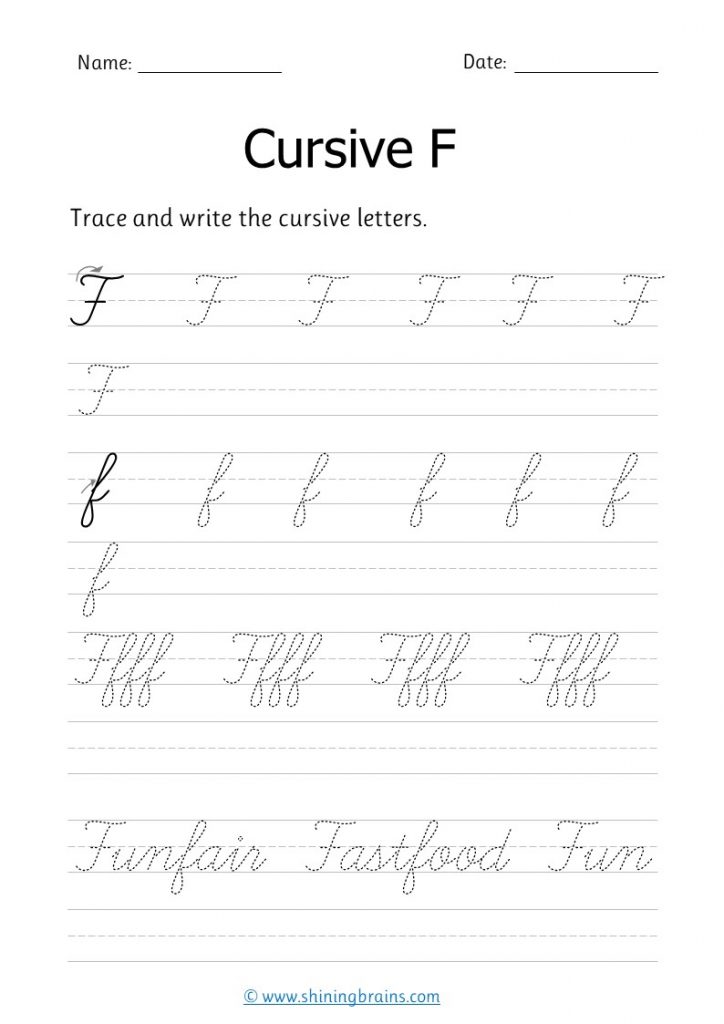
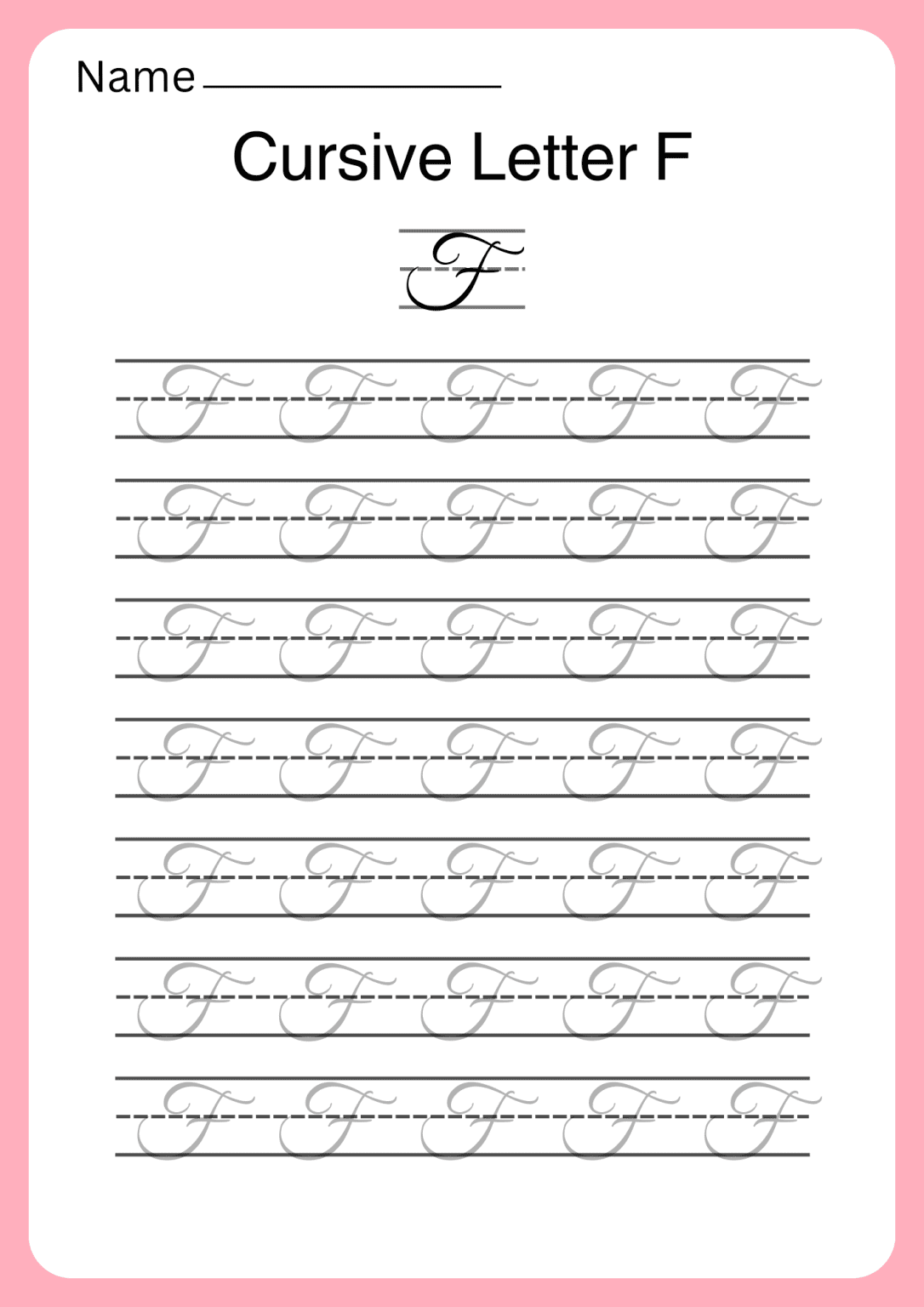
The free printable worksheet for the cursive capital f targets foundational mechanics by isolating stroke order, directional flow, and proportional spacing. Initial exercises guide the hand through the characteristic hat and stem, reinforcing the continuous motion required for legible cursive. It sounds simple, and that’s the point: removing extraneous visual clutter allows the developing brain to concentrate entirely on kinesthetic feedback. According to Reading Rockets, explicit instruction in letter formation is vital for reducing cognitive load during writing tasks, enabling students to eventually focus on composition rather than mechanical execution. When learners trace the subtle curves of the upper loop before descending to the baseline, muscle memory begins to form organically without requiring intense conscious oversight.
Key Learning Outcomes
Consistent interaction with this printable yields measurable improvements in pencil control and visual-motor integration. Students transition from shaky, segmented lines to smooth, confident strokes that respect standard baseline boundaries. This precision directly supports broader writing proficiency across various Worksheets designed for daily elementary practice. Furthermore, mastering the upper loop of the capital F prepares the hand for similar sweeping movements found in letters like T and P, creating a cumulative benefit for overall cursive fluency.
How to Use This Worksheet
Implementation requires more than simply handing a pencil to a child and watching from across the room. Adults must actively monitor grip posture, paper tilt, and body positioning to ensure optimal ergonomic conditions during practice sessions. Here’s what makes this worksheet different: it incorporates graduated sizing, moving from large-scale tracing models down to independent standard-rule execution. Practitioners should encourage finger-tapping or air-tracing the letter shape before the pencil ever touches the physical paper, engaging multiple sensory pathways simultaneously. Integrating these targeted printables alongside broader collections like Tracing Worksheets establishes a comprehensive foundation for early literacy success.
Practical Tips for Parents and Teachers
Establishing a low-stress environment transforms a frustrating handwriting drill into an engaging sensory experience. Try using scented markers, textured boards, or slightly damp chalkboards to make the initial tracing phase tactile and memorable for reluctant writers. Breaking practice into short, five-minute intervals prevents hand fatigue and maintains high cognitive engagement. According to the American Occupational Therapy Association, short and frequent fine motor sessions yield superior developmental outcomes compared to prolonged, exhausting drills.
Age-Appropriate Recommendations
Cursive instruction typically aligns with third-grade benchmarks under the Common Core ELA standards, specifically adhering to standard L.3.1.a regarding the creation of readable cursive text. Younger children in second grade may explore preliminary loops, but formal capital letter mastery requires the hand strength and bilateral coordination typical of eight-year-old development. Aligning practice expectations with the National Association for the Education of Young Children Developmentally Appropriate Practice ensures that tasks remain challenging yet achievable, preventing the anxiety associated with premature skill introduction.
Explicit instruction in letter formation significantly reduces cognitive load and enhances long-term writing fluency. — Reading Rockets
Frequently Asked Questions
Navigating cursive instruction raises common questions among educators and families supporting young writers at home or in the classroom. Reviewing concise guidelines helps ensure that practice time remains productive, accessible, and correctly aligned with established developmental milestones for fine motor growth.
Short, frequent fine motor practice sessions yield better developmental outcomes than prolonged, exhausting writing drills. — American Occupational Therapy Association
Explore More Free Printable Worksheets
Expanding a writing curriculum requires access to diverse resources that target different developmental stages and academic domains. Educators seeking to reinforce fundamental motor skills can easily browse additional offerings, including specialized Preschool Worksheets for younger siblings. Providing a rich variety of engaging writing prompts and structural exercises ensures that children remain motivated throughout their entire foundational education journey.
Developmental Milestone & Activity Table
| Development Stage | Recommended Daily Duration | Primary Learning Objective |
|---|---|---|
| Preschool & Pre-K | 10 – 15 Minutes | Pencil grip development & basic pre-stroke lines |
| Kindergarten | 15 – 20 Minutes | Letter/number formation & spatial line awareness |
| Early Elementary (Grade 1–2) | 20 – 30 Minutes | Fluency, sentence construction & neatness |
Images References