Introduction
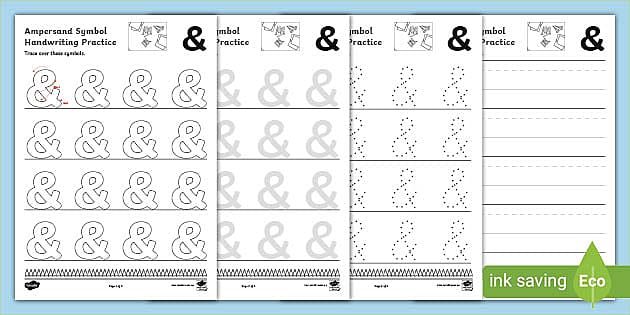
Mastering pencil control requires more than standard alphabet lines and basic vertical strokes. The free printable worksheet ampersand symbol drawing practice introduces young learners to one of the most complex continuous curves found in typography. Children often grip pencils with white-knuckled intensity when attempting unfamiliar loops, yet playful graphic symbols change this dynamic entirely. Exploring unique shapes helps build essential hand-eye coordination for early writers ages two through eight. It sounds simple, and that’s the point.
💡 Educational Key Takeaways:
- Core Skill: Structured Ampersand Symbol Drawing Practice focused on developing pencil grip, stroke control, and early literacy/math confidence.
- Target Scope: Suited for homeschoolers, preschool, kindergarten, and elementary learners.
- Best Recommendation: Practice 10–15 minutes daily with ergonomic writing tools to reinforce muscle memory without hand fatigue.
What This Worksheet Covers
This targeted resource focuses heavily on pre-writing strokes, pencil control, and line accuracy through the unique geometry of the ampersand. Educators observe that when children trace unconventional glyphs, they slow down their hand movements to process directional shifts. Rather than rushing through familiar straight lines, the continuous flowing loop of the symbol demands sustained visual-motor attention. Supporting broader foundational skills often connects back to specialized resources like Tracing Worksheets, which build the precise muscle memory required for advanced glyphs.
Key Learning Outcomes
Completing this exercise strengthens the small intrinsic muscles of the hand responsible for manipulation and endurance. According to the American Occupational Therapy Association, developing foundational fine motor control directly influences a child’s academic success and self-esteem during writing tasks. Learners practice maintaining consistent pressure from the top loop down through the sweeping tail of the character. This visual tracking and spatial planning translate directly into cleaner handwriting across all subjects.
How to Use This Worksheet
Adults should introduce the printable sheet during quiet morning work or occupational therapy stations when focus remains high. Children benefit from tracing oversized examples with a finger before ever touching a writing utensil to paper. Here’s what makes this worksheet different: it bridges the gap between casual doodling and formal letter formation by treating a punctuation mark as an engaging art puzzle. For additional skill-building exercises, pairing this activity with Preschool Worksheets ensures a balanced approach to early childhood education.
Practical Tips for Parents and Teachers
Shorter writing sessions yield better posture and less hand fatigue than marathon tracing drills. Observing a child grasp the crayon reveals whether fingers remain locked or fluid. Adults can encourage a dynamic tripod grip by using broken chalk or short golf pencils, which naturally prevent fist grasps. Ensuring the workspace features proper chair and table heights prevents slouching and stabilizes the core for optimal distal hand control.
Age-Appropriate Recommendations
For younger children around ages three to five, scaling the activity down to large-format finger tracing or painting yields the best results. Older children in early elementary grades can refine their precision by maintaining continuous pencil contact throughout the entire shape. According to the National Association for the Education of Young Children Developmentally Appropriate Practice guidelines, tasks involving fine motor manipulation must align with physical maturity rather than chronological age alone. When learners struggle with fluid stroke transitions, integrating materials from Letter Writing Worksheets offers supportive scaffolding for similar curved motions.
Foundational fine motor control directly influences a child’s academic success and classroom confidence during early writing tasks. — American Occupational Therapy Association (AOTA)
Frequently Asked Questions
Getting started with printable resources is straightforward when utilizing standard desktop configurations.
Explore More Free Printable Worksheets
Expanding a child’s toolkit of writing resources keeps engagement high throughout the school year. Exploring options like Worksheets provides comprehensive practice across various developmental domains.
Developmental Milestone & Activity Table
| Development Stage | Recommended Daily Duration | Primary Learning Objective |
|---|---|---|
| Preschool & Pre-K | 10 – 15 Minutes | Pencil grip development & basic pre-stroke lines |
| Kindergarten | 15 – 20 Minutes | Letter/number formation & spatial line awareness |
| Early Elementary (Grade 1–2) | 20 – 30 Minutes | Fluency, sentence construction & neatness |
Images References