Introduction
Children often internalize their early writing struggles, transforming a simple motor challenge into a fixed belief about capability. Integrating positive affirmations worksheets into daily routines bridges emotional well-being and foundational academic readiness. When young learners trace, color, or write encouraging phrases, neural pathways for both emotional resilience and fine motor control fire simultaneously. Classrooms and clinic spaces regularly reveal how a child’s posture shifts the moment positive messaging combines with purposeful pencil manipulation. Relaxation replaces the tight, white-knuckled grip commonly seen during frustrating writing tasks. It sounds simple, and that is the exact point of blending mindset work with early skill acquisition.
💡 Educational Key Takeaways:
- Core Skill: Structured Positive Affirmations Worksheets focused on developing pencil grip, stroke control, and early literacy/math confidence.
- Target Scope: Suited for homeschoolers, preschool, kindergarten, and elementary learners.
- Best Recommendation: Practice 10–15 minutes daily with ergonomic writing tools to reinforce muscle memory without hand fatigue.
What This Worksheet Covers
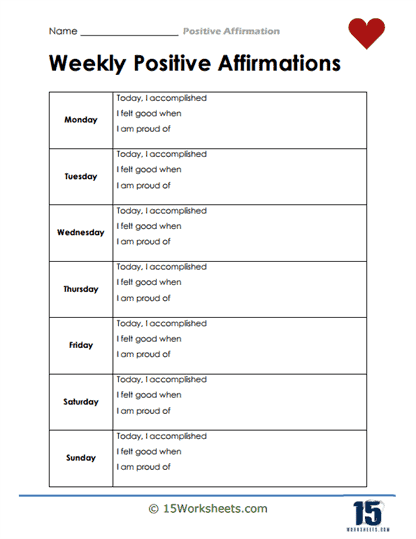
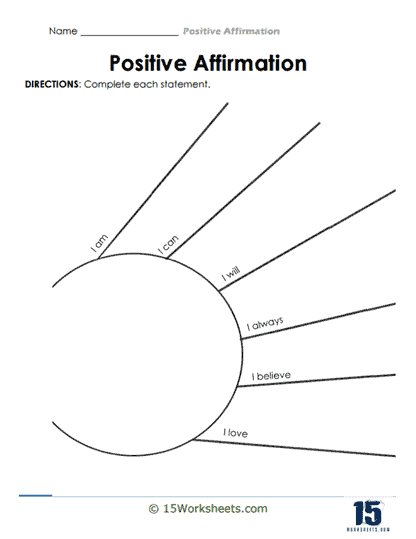
Targeting the intersection of mental health and physical dexterity, these pages feature uplifting statements tailored for developing minds. The physical act of moving a writing tool across the page reinforces motor planning while cementing encouraging vocabulary. Children practice letter formation, stroke sequencing, and spatial awareness while absorbing messages of self-worth. Exploring these concepts alongside related resources such as tracing worksheets helps young learners build hand control and line accuracy without feeling overwhelmed. Every curve and line serves a dual purpose: building physical hand strength and nurturing a confident inner voice.
Key Learning Outcomes
Developing fine motor precision requires refined intrinsic hand muscle activation, which these printables support through varied tracing and writing prompts. Children build bilateral coordination by stabilizing the paper with one hand while manipulating the writing utensil with the other. According to the American Occupational Therapy Association, foundational fine motor tasks directly support a child’s ability to engage successfully in daily academic routines. Beyond muscle endurance, learners expand their emotional literacy by reading and reproducing positive statements independently. This dual approach ensures that physical fatigue does not derail emotional confidence during longer seated activities.
How to Use This Worksheet
Establishing a calm, inviting environment sets the stage for success before any writing tool touches the paper. Adults should model proper pencil grasps and posture, ensuring feet rest flat on the floor to provide proximal stability for distal hand mobility. Here’s what makes this worksheet different: it invites conversation about feelings before the physical writing begins. Educators and parents can read the affirmation aloud, discuss its meaning, and then guide the child through the motor patterns required to complete the page. Pairing these exercises with complementary materials like preschool worksheets broadens early developmental gains across multiple domains.
Practical Tips for Parents and Teachers
Short, frequent practice sessions yield better motor outcomes than long, exhausting drills that lead to hand cramping. Breaking a single page into manageable chunks prevents frustration and maintains the positive emotional tone of the affirmation itself. Observing children in clinic settings shows that offering broken crayons or short pencils naturally encourages a functional tripod grasp. Adults should praise the effort and the physical persistence required to form letters rather than focusing exclusively on neatness. Utilizing tools from collections like worksheets keeps the learning experience fresh, engaging, and developmentally appropriate.
Age-Appropriate Recommendations
According to the National Association for the Education of Young Children Developmentally Appropriate Practice guidelines, expectations must align with the physical maturation of small hand bones and ligaments. Two-year-olds benefit most from large, sensory-rich coloring interactions, while four-year-olds begin mastering pre-writing strokes and directional consistency. Kindergarteners and early elementary students can tackle full sentence construction and independent affirmation copying. Matching the exact formatting of the resource to the child’s current fine motor stage prevents undue physical strain and fosters genuine intrinsic motivation.
Foundational fine motor skills and emotional regulation develop in tandem, reinforcing academic persistence during early childhood. — American Occupational Therapy Association
Frequently Asked Questions
Caregivers often wonder how best to introduce positive affirmations worksheets without creating performance pressure. The answers below address common printing, developmental, and instructional inquiries to ensure a smooth, enjoyable learning experience.
Young children thrive when early writing tasks incorporate meaningful emotional messaging alongside physical skill practice. — Reading Rockets
Explore More Free Printable Worksheets
Expanding a child’s learning library with diverse, targeted printables ensures comprehensive skill development across all developmental domains. Combining emotional health exercises with specialized practice sets up young learners for long-term academic success. Additional targeted practice is readily available through resources like letter writing worksheets for advanced stroke control. Exploring varied collections maintains high engagement and supports continuous, joyful progress throughout the early childhood years.
Developmental Milestone & Activity Table
| Development Stage | Recommended Daily Duration | Primary Learning Objective |
|---|---|---|
| Preschool & Pre-K | 10 – 15 Minutes | Pencil grip development & basic pre-stroke lines |
| Kindergarten | 15 – 20 Minutes | Letter/number formation & spatial line awareness |
| Early Elementary (Grade 1–2) | 20 – 30 Minutes | Fluency, sentence construction & neatness |
Images References